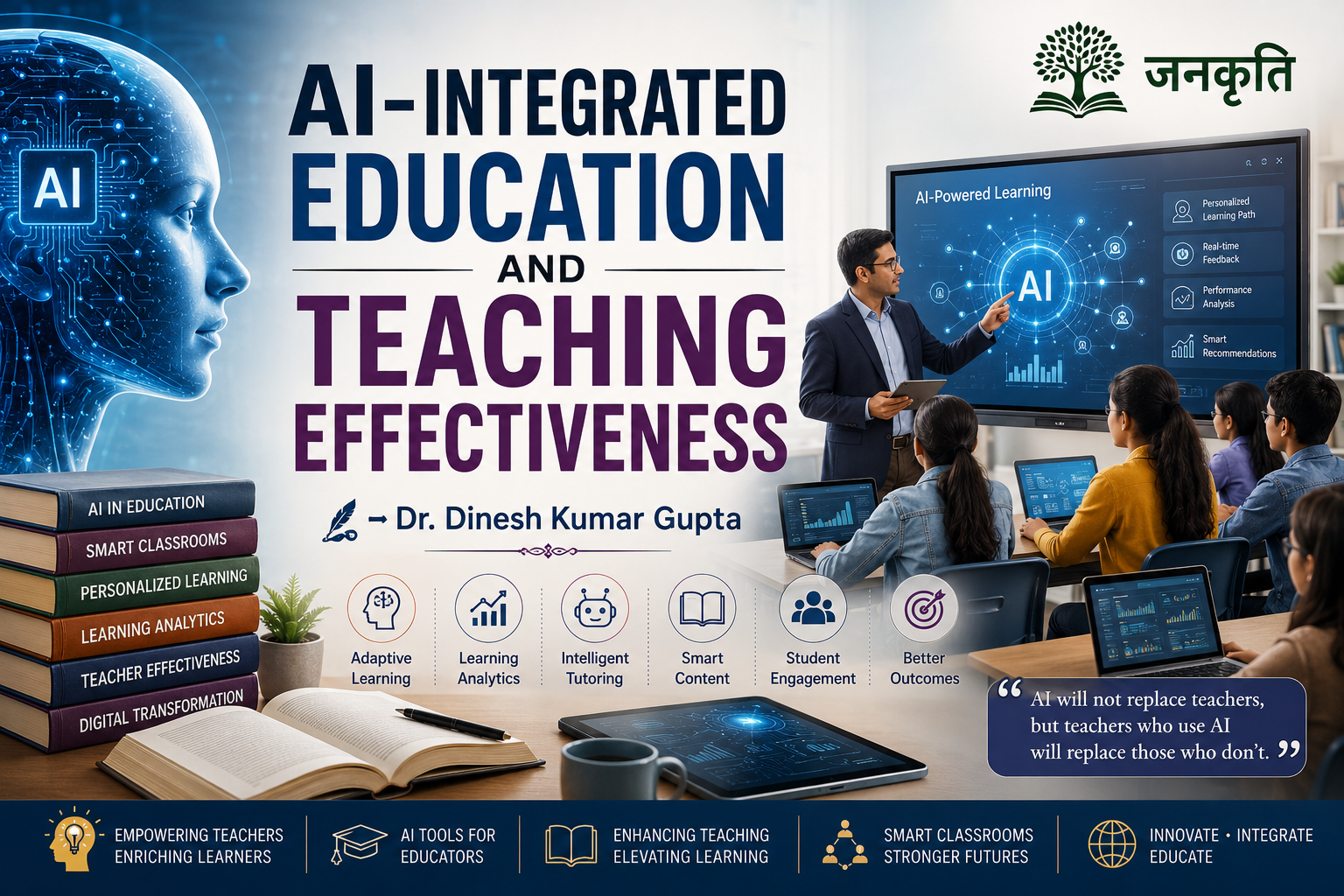
AI-integrated Education and Teaching Effectiveness
Dr. Dinesh Kumar Gupta
Assistant Professor
Agrawal Mahila Teacher’s Training College, Gangapur city (Raj.)
Mail: dineshg.gupta397@gmail.com
Mobile: 9462607259
Abstract:
The 21st century has been regarded as the era of information and technologies and also proving it very much through the advent of Artificial Intelligence (AI). As a technological tool AI has changed the faces of society and markets a lot. Siri, Alexa, chatbots and so on, the promising tools of AI, are being used in deducting the customers’ preferences in making choices in on line shopping based on their past actions and experiences. Queries support system of banks, airlines, telecom companies and so on are being handled by AI enabled system too. Similarly, education sector has also become one of the subject matters of AI. It is a computer programme also known as machine learning system that can think, act, recognise the faces, deduct the objects and images, and follow the instructions as a human being can do. Many of the scientists are opined that AI is the future of education system and days are not far away when the entire educational activities including teaching-learning process may fall dependent on AI driven education system. Considering the potential applications and effectiveness of AI in education system, present article posits to explain the meaning, concepts, potential applications, effectiveness and challenges of AI with respect to Indian education system. Like any technology, AI also has some pros and cons in regard to its applications. AI driven education system may have some negative impacts like deterioration of values, threat to human civilisation, potential health risk of learners and staff, reduction in employment opportunities for traditional teachers, complete dependency on technology, learning gap, issues of data management and cyber securities and so on.
Key Words: Artificial, Intelligence; Promising, Applications
Introduction
The future of Indian education system is seem to be technology oriented as it got serious consideration in the NEP-2020. Considering the key factors associated with success of education system of developed countries, policy makers have arrived at the conclusion that educations system must be transformed and restructured to make the people ready to receive Artificial Intelligence (AI) that has the capacity to transform the entire education system and can lead it to the path of improvement as needed. Acknowledging the fact, AI has been given due emphasis over the traditional means of technologies used in education system. Along with AI, Code Language and 3-D Graphics are also given place in NEP-2020 (Ministry of Education, 2020) so that in future, foundations of education can be visualised as technology oriented. Technology enabled education system is considered to have potential to make shift the entire education system as per the need of hours. Like the MOOCs, a recent online, prerecorded education programme has made significant impact on the education system particularly in on going covid-19 pandemic when the teachers and students are restricted to attend the offline academic programmes, AI may also play vital role in catering the needs of millions of students of different realm of education system if the education system is ready to involve or make use of AI in educational functions including the teaching and learning process. AI has been recognised globally as a promising and potential effective educational tool to be used for different purposes in the field of education.
Artificial Intelligence (AI): Meaning and Concept
The history of Artificial Intelligence (AI) can be traced from 1950 when Allen Turing, recognised as the father of AI, developed a ‘Turing Machine’ which was enabled with like a computer programme that shows human like intelligence. But, the term AI coined by John McCarthy in 1956 who has defined AI as “the science and engineering of making intelligent machine.” Further, he defined it as “the study (of artificial intelligence) is to proceed on the basis of the conjecture that every aspect of learning or any other feature of intelligence can be in principle be so precisely described that a machine can be made to simulate it” (in Russel & Norvig, 2010). Artificial Intelligence (AI) is a machine which is considered to have the ability to perform assignments and resolve the certain issues and problems as a human being does. It may also be explicated as a system of computer programme which can do tasks which generally required human intelligence like resolving complicated problems, making choices and decisions, objects deduction, images and faces recognition and so on. (Zulekha, 2019). In general, it is an electro mechanical process of a machine that thinks, understands the languages, solves the problems, perceives and anticipates the environment, adapts the situations, anticipates the actions and so on. Adaptability, learning and anticipatory actions are considered as the key characteristics of AI (Ilkka, 2018, p.7).
Stages, Types and Domains of Artificial Intelligence (AI)
Following are the Stages, Types and Domain of Artificial Intelligence as categorised and explained by Zulekha (2019).
Stages of Artificial Intelligence (AI)
Following are the three stages of AI.
- Artificial Narrow Intelligence (ANI): It is also called as weak AI. It is the stage where AI includes machines that can do only specifically defined set of tasks. At this juncture, machines can carry out only those tasks which are predefined as it do not have thinking abilities. For examples-Siri, Alexa, Sophia, Alfa Go, the self-driving cars and so on.
- Artificial General Intelligence (AGI): It is also recognised as strong Artificial Intelligence (AI) and is considered as the advancement of AI where machines will have the thinking abilities and will able to make decisions as human beings do in general. But at present, we do not have such machines and it is being anticipated that scientists must come up with the machines which will be as smart as human beings. Whereas, many scientists has opined that the AI is considered as the menace to human civilization. Moreover, Stephen Hawking pointed out that the “development of full Artificial Intelligence could spell the end of human race.”
- Artificial Super Intelligence (ASI): By this stage of AI, computers’ abilities will outshine the human beings’. Though, it is considered as the assumed or hypothetical stage showed in scientific movies and science fiction books where things are shown that how the machines will take over the world in future.
Types of Artificial Intelligence (AI)
Based on the functions, AI can be categorised into four types.
1. Reactive Machine Artificial Intelligence (RMAI): Such kinds of machines work only on present data by considering the present situations. RMAI cannot decipher inferences from the data in connection to evaluations of their futures course of actions.
2. Limited Memory Artificial Intelligence (LMRI): As the name advocates, it has limited memory and can have refined, informed and improved decisions from the memory of its past data. This kind of AI has the memory useful to store past experiences and for the evaluation of future course of actions.
3. Theory of Mind Artificial Intelligence (TMAI): It is regarded as the advanced kind of AI, and is predicted to have vital role in human psychology. The theory of Mind Artificial Intelligence puts emphasis on emotional intelligence for having better understanding about the pattern of human thoughts and believed. However, such kind of AI is not found fully developed yet but in this perspective many researches are going on round the clock. .
4. Self-aware Artificial Intelligence (SAAI): It comprises the machines which may have the power of their own developed consciousness that may lead to become self-aware. Like the theory of Mind Artificial Intelligence, it is also not developed yet. In this regard, Elon Musk (n.d.) has warned that “AI is a fundamental risk to the existence of human civilization.”
Domains of Artificial Intelligence
Following are the different domains Artificial Intelligence (AI).
- Machine Learning: It is a science that gets involve the machines in order to solve the problems by processing, analysing and interpreting the data. Machine learning can supervise the unsupervised and reinforcement learning.
- Deep Learning: It is also called as neuron network. The deep learning is concerned with executing neuron networks on high demands data to deal with insights and formulate solutions. The logics behind it are the face verification algorithm on Facebook and self driving cars that said to have assistants like Siri and Alexa.
- Robotics: It emphasises on the applications of robots. AI robots are like the artificial agent which works in real world situations for producing results by taking into account the some actions. Sophia is named as the good example of the AI in robotics.
- Expert Systems: It is a domain of AI in which computer system learns as well as reciprocates with the ability of decision making of a human expert. It can use its logic notions in resolving the complex problems. Expert System domain of AI does not depend on the conventional programming system rather on more advanced programme. It is used in information management there seen to use in fraud deduction, virus deduction and also in managing medical and hospital records and so on.
- Fuzzy Logic: It is a computing based approach where it works on the principle of degree of truth. Fuzzy Logic is the Boolean Logic. It has the utility in medical field in terms of resolving complex problems including decision making issues. Moreover, it is also useful in performing the task of automating the gas system in cars.
- Natural Language Processing (NLP): It is a system of processing the natural language which is called as the science of drawing insights from the natural language of human being. NLP is used in order to communicate with machines and online businesses, and the examples of NLP are Twitter and Amazon. Twitter uses NLP to analyse the fake news and abusive languages, and to filter out the terroristic languages from the tweets whereas Amazon uses NLP to understand and analyse the customers’ feedbacks and improves the users experience as well.
Indian Education System and Artificial intelligence (AI)
The Indian education system particularly in regard to AI has been devoid of reflecting any intention to accommodate and adapt AI till the New Education Policy (NEP-2020) got cabinet nod for implementing at nationwide in July 2020. Academic discourses within the institutional boundaries are negligible except few that too in the discipline of computer science, engineering and management studies. We would say that AI in the common or general education system is at infancy stage where it has just started scrolling slowly as the Ministry of Education has put promising emphasis on introducing the Machine Language, AI and 3-D graphics in the education system of India so that the Indian education system can be at par to the global education system in which education is being imparted through AI of much advance level from years before. However, Central Board of Secondary Education (CBSE), New Delhi, India has decided to incorporate the AI in its school curriculum.
As per an article only 15 % teacher of government schools are trained in handling the computer. Whereas, only 3 % of the government and private school teachers of the states like Bihar, Madhya Pradesh and Mizoram were reported trained in computer as compared to the states like Goa, Punjab and Maharashtra where more than 50% school teachers including government and private were found trained in the same (Sen, Nihalani & Radhakrishnan, n.d.). As per the report of Ministry of Education-UDISE (2019-20) that only one forth teachers in India were reported trained to deal with the technology oriented teaching learning process where as 83.43% of the total schools of all management (government, government aided & private) had electricity supply, however only 80.16% schools were reported to have functional electricity connection. While, only 22.28% of all management schools in India had internet facility. Moreover, only 38.54% schools of all management of which only 30.03% of government, 62.97% government aided and 59.88% of private schools had computer facility. Similarly only 37.13% of the all management schools in India of which only 28.55% of the government, 61.84% of government aided and 58.48% of the private schools were found to have functional computer facility.
In spite of National Policy on ICT in school education (2012) through which ICT enabled teaching leaning process and enhancement of ICT literacy and competency was given top priority, the reality of facts and figures mentioned in UDISE-2019-20, realising the conceptualisation of AI in general education system of Indian including schools and universities is not like a bed of roses rather hard nut to crack as even in 21st century the significant proportion of teachers are untrained in technologies, limited schools have functional electricity supply, internet connections and computer facilities which have been recognised as inevitable to go with the potential, effective and promising uses of AI in the different realms of education system. In this connection, a revolutionary and insightful efforts like National Literacy Mission (1988) and Operation Blackboard (1987) is needed to launch at nationwide to revamp and establish the essential infrastructures required for AI, it would be better to have a National Policy on AI including Code Language and 3-D graphics in school and university education similar to the National Policy on ICT (2012).
Artificial Intelligence: Promising Applications and Potential Effectiveness
AI has become globally recognised as a techno potential tool which could fetch effectiveness in educational functions and practices if uses properly and effectively. Having been establishment of its effectiveness by many scientists of the world, it has also been regarded as the threat to human life as well. However, business houses and educational field has the vast scope of its promising applications and potential effectiveness, but the range of potential effectiveness is determined by the intentions and objectives of its uses.
Decades ago futurists, science fictions, scientific movies and many more scientists were insinuating and predicting about the cataclysmic and catastrophic changes may happen in the life of people and in society too with the advent of fast changing face of AI and its applications. Widespread of AI in the 21st century has been creating the avenue of its effective, reliable, potential and promising uses particularly in auto driven cars, business houses like Amazon & Flipkart. Moreover, queries support system of airlines, banks, food delivery apps and other virtual sopping platforms are using AI driven chatbots (Makkar, 2019). Similarly, education is also one of the sectors where AI can make effective and potential changes.
In connection to potential effectiveness, promising applications of AI in educational functions and practices are explained as follows.
- Personalised Learning Opportunity: AI Driven teaching learning process could come with more suited teaching techniques and strategies and could adapt to the students’ learning pace and behaviour easily. In AI enabled personalised learning, students will gets learning experiences as per their needs; those comfortable with audio and video materials will has that, students comfortable with text materials will get that and so on.
- Delivery of Quality Content: Preparation and delivery of smart contents is the key matter of pedagogical aspects. AI assisted and driven system can create and deliver the quality content in the forms of audio and video and also by turning the traditional text books into digital one. New learning interface can be created that can be helpful to the students of all levels and grades. Cram101 and Netex is helpful to teachers and enable them in developing e curriculum, AI devices driven more comprehensive syllabus with much illustrated audios and videos (Agarawal,2020).
- Equality and Equity in Learning Opportunity: If we keep all the constraints neutral, AI enabled education system is considered as a tool to ensure equity in access to education for everyone. Millions of learners are either studying or trying to enrol in schools, colleges and universities deserve to access good education. AI enabled education system can ensure more equalise and equity learning opportunities to the learners as the personalised e-curriculum, tutorial programme, skill based learning applications are being developed at global level wherein AI driven system will bring classrooms at fingertips and can empower the learners to access the education as per their needs and abilities and may also get upgrade themselves with the trends of global education.
- Interactive Teaching-Learning: AI enabled education system is consider to be more interactive as it provides individualised opportunities of interaction. Algorithms, a machine learning and AI driven programme can follow the instructions of learners as many times as can be. This enables the learners to have queries, clear doubts, understand the concepts, revisit and customise the contents without much effort.
- Remote Learning: Remote learning is one of the subjects of AI driven system of education. AI can make possible to everyone who wishes to attend classes from home or remote as it can stream the e-content in the forms of audio and audio-visuals on instructions. AI can be a boon to millions of rural learners who may be unable to attend the institutions but can access the AI driven electro-mechanised education system at their fingertips.
- Curriculum Up gradation: AI enabled education system can have predictions about the worthiness and compatibility of curriculum with the students. It can evaluate and suggest the methods, skills and strategies of teaching; contents, activities, examinations patter and system suited to the different students. It can enable the education system to have regular up gradation of curriculum as per the need, interest and compatibility of the students by providing feedback and future predictions.
- Dropouts Management: Drop outs are caused by various reasons. It is quite tough to analyse ever reason causing to potential drop outs but it is predicted that AI driven system can identify the list of potential drop outs. However, government of Andhra Pradesh, along with Microsoft AI, has successfully piloted a project of identifying and managing drop outs in Vishakhapatanam (Bhaduri, 2020). AI enabled device can make predictions through actions recognition, performance and reasons analysis of the students’ performance, actions and potential causes lead to dropping outs them from the schools.
- Assessment and Grading: AI can do assessment and grading concurrently that teachers required days to do. AI driven system can do it by making audio and video streaming, recognise the images and faces as the human can do during the proctored assessment while writing examinations. So it can recognise and understand the actions of examinees, read the answer script and do the grading with accuracy as per the performance and merits of the students. Moreover, AI enabled tool may also reduce the marathon exercises of conducting home and competitive examinations as it can do all exercises through image, face, actions and instructions recognition abilities.
- Research Activities: It is predicted that AI may also helpful in research activities through text, script, image, face and voice recognition ability. Finding related studies, selection of research design with reasons, coding, weeding out data, analysis, interpretations and so on may be possible in future if AI enable technologies become common in use.
- Assistant to Differently abled Learners: AI driven teaching learning process could meet out the needs of differently abled learners as it can map the each and every learner’s needs and capacity by their faces, images and voice recognition that help AI to help them out individually in all teaching and learning matters. It could also be succeed in establishing inclusive learning environment and could come up with the best teaching methods and learning materials suited to them than a normal teacher could fail in doing so. Moreover, it can make huge difference by doing swat analysis of such students and can understand their learning gap as well and adjust to their pace and style of learning accordingly.
- Remote Proctoring: AI enabled teaching learning process, examinations and other activities of leaners could be monitored from the remote by AI through face, voice, and actions recognition abilities it has. As with the help of algorithms, AI receives as well understands human instructions and actions, and transmits the same to the required ends.
- Resources and Events Management: AI may be helpful in optimising the use of institutions’ resources. It may locate where the files or records are kept and also furnish the record whatever and whenever needed. In Events management, AI enabled robot or algorithms may reduce the manual exercises as it could do the works of many staff required at different points and time through face and actions recognition; object deduction, and by following the instructions as human being could.
- Feed Back: By the virtue of unique ability of face, script, image recognition and deduction, and by following the instructions including human actions AI can give the immediate feedback as it keeps on working on the students’ performance trends individually while carrying out the teaching learning process or other activities. Immediate feedback to the students and as well other concerned on students current and future academic performance can be possible in AI enabled teaching learning process.
- Training and Skills Development: Studies predict that training and skill development programmes for the teachers and others staff can be possible efficiently by using AI. As the AI enabled computer programme may read the instructions, recognise the faces and images of participants as the human being does. Instilling the skill into the teachers is possible by devising the AI enabled training programme. Need based one to one training shall also be possible. Moreover, AI can follow the instructions (voice or actions) and reciprocate accordingly. Apart from the points explained, an AI enabled education system can ease the administrative tasks, protect the data, ensure cyber security, ensure accuracy and accessibility, and also assist the teachers and intuitions in many aspects.
(i) Resistant from society and parents to accept the AI driven education system fully, (ii) Socio-religious taboos in adapting AI, (ii) Socio-economic back ground of learners, (iv) Government’s casual approach,(v) No dedicated policy on AI at national level, (vi) Schools’ inability to adapt the AI driven education system, (vi) Financial exchequer, (vii) Poor infrastructures at every ladder of education, (viii) Sustained functional electricity supply, (ix) Sustained functional internet connectivity, (x), AI trained staff, (xi) Awareness gap among the students, (xii), Public and Private; Urban and Rural gap among the students’ approach to AI, (xiii) Absence in emotional aspects, (xiv) No physical involvement of teachers, (xv) Possibility to deterioration of value system, ( xvi) Teachers’ place and respect at risk, (xvi) Sharp cut in employment opportunity for teachers and other staff, (xvii) Threat to cyber security, (xviii) Data management issues, (xix) Issues of correct programming of AI, (xx) equality and equity in access to AI enabled education system, (xxi) Potential threat to human civilisation and race, (xxii), Information and data based education than knowledge based, (xxiii) Staff and Students’ at potential health risk, (xxiv) Potential encouragement to materialistic society, (xxv) Arts and Humanities subject at the risk of fading away, (xxvi), Possibility of centralised control of entire education system, (xxvii) No chance of guidance and counselling, (xxviii) Over AI dependent education system and so on.
Conclusion
Artificial Intelligence is regarded as a system of machine learning or computer programme that can do what a human being can do. If any technology that has the capacity to cast catastrophic impact and bring change in the society of 21st century we would name to the Artificial Intelligence. AI has become one of the highly debate inviting issues among the scientists, educationists, policy makers and other stakeholders of education system. AI is considered to be the custodian of future education system at every level if it gets full coverage in implementation and application in the educational realms as it has the promising applications in education system with respect to teaching learning process, administrative tasks, managing resources and events, assessment and grading, equal opportunity in access to education, remote and proctored learning, curriculum up gradation, predictions about potential drop outs, inclusion oriented education system and so on. However, AI enabled education system is still in infancy stage. Socio religious taboos, students’ abilities, proper policy on AI, essential infrastructures, financial constraints and so on are the potential issues and challenges pertaining to AI enabled education system. Moreover, functional and sustained electricity connection, internet connectivity and trained staff in AI programming is inevitable to ripe the effective and desired results out of its potential uses in the education sector.
Reference
- Agarwal, A. (February20, 2020). How Artificial Intelligence is transforming the education system. DTAQUEST. Retrieved on October 16, 2020 from https://www.dqindia.com/artificial-intelligence-transforming-education-system/
- Bhaduri, N. (April 23, 2020). Artificial Intelligence (AI) in Indian Education. Sight in Plus. Retrieved on October 26, 2020 from https://sightsinplus.com/ insight/learning/artificial-intelligence-ai-in-indian-education/
- Ilkka, T. (2018). The Impact of Artificial Intelligence of Learning, Teaching, and Education. JRC Science for Policy Report, Luxembourg: Publication Office of the European Union. Retrieved as on July 7, 2019 from http://publications.jrc.ec.europa.eu/repository/bitstream/JRC113226/jrc113226_ jrcb4_the_impact_of_artificial_intelligence_on_learning_final_2.pdf
- Makkar, A. (2019). How Can AI be Effectively Used in the Indian Education System? Entrepreneur India. Retrieved on October 26, 2020 from https://www.entrepreneur.com/article/337165
- Ministry of Education. (2020). New Education Policy on Education. Government of India. Retrieved on August 11, 2021 from https://www.education.gov.in/sites/upload_files/mhrd/files/NEP_Final_English _0.pdf
- Ministry of Human Resource Development. (2012). National Policy on ICT in School Education, Department of Literacy and School Education, Ministry of Human Resource Development. Government of India. Retrieved on August 11, 2021 fromhttps://www.education.gov.in/hi/sites/upload_files/mhrd/files/upload_docu ment/revised_policy%20document%20ofICT.pdf
- Ministry of Education. (2019-20). Unified District Information System for Education Plus. Department of Education and School Literacy, Government of India. Retrieved on August 11, 2021 from https://udiseplus.gov.in/#/Publication
- Musk, E. (n.d.). Types of Artificial Intelligence. Edurekha.com. Retrieved on July 9, 2021 from https://www.youtube.com/results?search_query=types+of+artificial+ intelligence
- Russell, S.J, & Norvig, P. (2010). Artificial intelligence: a modern approach, (3rd ed.). Upper Saddle River: Prentice-Hall. In Popenici, S.S.D, & Kerr, S. (2017). Exploring the impact of artificial intelligence on teaching and learning in higher education. Research and Practice in Technology Enhanced Learning, 12(12), 1- 13. Retrieved as on August 8, 2021 from https://telrp.springeropen.com/articles/10.1186/s41039-017-0062-8
- Sen, S., Nihalani, J., & Radhakrishnan, V. (n.d.). Teacher Face Digital Hurdle. Data Point.
- Trust Radius (n.d.). Higher Education Software. Retrieved on August 06, 2021 from https://www.trustradius.com/higher-education
- Zulekha. (2019, July I5). Types of Artificial Intelligence. Edurekha.com. Retrieved on July 9, 2021from https://www.youtube.com/watch?v=y5swZ2Q_lBw&ab_channel=edureka%21