Home Blog Page 4

Womens Participation in Panchayati Raj Institution-Umesh jatav

0

Womens Participation in Panchayati Raj Institution

Umesh jatav

MA,LLB(2nd year)

Law centre 1(Delhi University)

Abstract

The concepts of Gram swaraj and Panchayati raj were integral part of Gandhiji s political vision about the future of our nation. Panchayats which now have been the backbone of the Indian villages since the beginning of the recorded history. Gandhiji s dream of every village being a republic or Panchayats having powers has been translated into reality with the introduction of three-tier Panchayati Raj system to enlist people’s participation in rural reconstruction.The 73rd Constitution Amendment has brought significant changes that promote equal access and increased engagement of women’s in politics. About one-third of total Constituencies have been reserved for women. It also ensures and enhances women’s participation in public life. It strives to achieve National policy for women at the grassrootlevel. The commencement of the reservation system in the Panchayati raj institutions empowers women and elevates women’s economic, social, and political status in society.Democracy ensures empowerment, while Panchayat Raj Institutions (PRIs) guarantees participation of all segments of society in the process. Greater gender equality is the key to successful participation of women in any democracy.

Key words: Panchayat Raj,Women,Gender equality.

Research Article

Panchayat Raj was in existence during Vedic period in ancient India and was working well as the people were carrying out their personal and official duties based on ‘Dharma’. The life of the people was peaceful and fruitful as there were limited desires of the people.The ‘Gram Swaraj’ dream of Mahatma Gandhi and the ‘Power to the People’ dream of Rajiv Gandhi are the essence of true democracy.Democracy, Development and Decentralization through local self-government, transforms representative into participatory democracy. The Indian federal system provides for the constitutional devolution of powers between the center and the states, under whose exclusive legislative domain the local self-governments rest as third tier or level of government. In the Quasi-Federal system of India’s parliamentary democracy, the creation of grassroots organizations was left to a general directive embodied in Article 40 of the Constitution for the following terms: “the State shall take steps to organize village Panchayats and endow them with such powers and authority as may be necessary to enable them to function as unit of self-government”. In fact, the true potential of Article 40 lies not merely in its directive to the Indian State at all levels as a part of Directive Principles of State Policy to organize village Panchayats but its significant concomital mandate that Panchayats should be endowed with “such powers and authority as may be necessary to enable them to function as units of self-governments”. It was pointed out that the task and expectations of the founding fathers of the Constitution world remain incomplete unless the village Panchayats begin to function as units of self-government and also as a part of our democratic polity. In this way, it was attempted to conceptualize the framework of Panchayat institutions and allow it to take its inspiration from the constitution with a view to improve their functioning which is bound to have ramifications for our democracy and development. In addition to the above Article,

Balwant Rai Mehta Committee (1957) was the first committee that recommended the establishment of the scheme of ‘democratic decentralization’ which ultimately came to be known as Panchayati Raj. Other most important committees were Singhvi Committee, Ashok Mehta Committee. All these committees recommended ‘democratic decentralization’ through two or three tier Panchayat Raj system.Panchayati raj was launched on October 2,1959, (Father of the Nation Mahatma Gandhi’s birthday) in Nagaur district in Rajasthan State. In the same year Andhra Pradesh State also introduced the system. Soon after, many states established Panchayati Raj Institutions (PRIs) in their respective states.

The three tier system of Panchayati Raj came into existence in many states during the 1950s and 1960s. The Panchayat Raj System consisted of the Gram Panchayats at village level. The Panchayat Samities at Talukaa or block level and the Zilla Parishads at district level. Hence, all the Units of local government were the creations of the State Governments. Since this became a potent hurdle in the way of development of these institutions, the Government of India under the leadership of Rajiv Gandhi wanted to provide onstitutional basis for the local bodies. Accordingly, the Government introduced a Bill in both the House of Parliament in the name of the Constitutioin (Seventy-third) Amendment Bill seeking to provide for constitutional status to the Panchayat Raj bodies as well as to strengthen them. The Lok Sabha passed the bill on the 22nd December, 1992 and Rajya Sabha passed it on the next day with near unanimity. Thus the Act came into effect on 23rd December, 1992.

Democracy ensures empowerment, while Panchayat Raj Institutions (PRIs) guarantees participation of all segments of society in the process. Greater gender equality is the key to successful participation of women in any democracy. Central and state governments have implemented many programmes to provide equal opportunities in education, employment and to improve economic status of women. As a result of this, status of women in India has been subject to many changes over the past two decades. When independence was declared, Mahatma Gandhi observed: ‘As long as women of India do not take part in public life there can be no salvation for the country; the dream of decentralization could never be fulfilled. I would have no use for the kind of Swaraj to which such women have not made their full contribution. Gender inequality is a major concern and government of India alongside various state governments have been engaged in a number of intervention programmes aimed at empowering them in true sense. Empowerment of women is the process of strengthening the economic, social and political status of women in society by which they have dignified and well-regarded life. One of the major interventions used by women empowerment promoters is to empower women through the panchayat raj institutions (PRIs) thereby to ensure their participation in the process of political decision making. The 73rd constitutional amendment is a milestone mainly for two reasons: a. it facilitated local empowerment and b. it ensured women’s empowerment. It provides 33 percent (one third of the total number) reservation in panchayat seats for women. This act also provides reserved seats for Scheduled Castes (SCs) and Scheduled Tribes (STs) in proportion to their population. Same proportions (one third) of the offices of chairpersons of panchayats have been reserved for women. Currently the reservation quota for women is set at 50% at PRIs level.

The constitutionally mandated reservations in Panchayat Raj Institutions (PRIs) brought in through 73rd amendment have ensured women in general and from the marginalised groups in particular to participate in decentralisation process and thereby village and community development. Over and above several region specific Acts enacted by the state governments, the 73rd amendment to Constitution enacted in 1993 is a major strengthening pillar to decentralised process, which recognises the need for uplifting rural women along with other socially, economically and politically weaker sections of the society by making them part of administration and development. Government of India has been trying to achieve empowerment of women through various programmes and constitutional safeguards. Economic empowerment has been targeted or recognised through women component plan, financial assistance to self-help groups, establishment of women operated banks, colleges and universities specifically established for women, social empowerment being cherished through free education to girls up to certain levels, housing schemes, access to services, etc. Political empowerment is assured through reservation of seats for contesting elections at different levels, earmarking of funds under reserved category, etc. In PRIs, the provision of seats has been increased from 33% to 50% for women.

Issues faced by women while participation in Panchayati Raj Institutions

(i) Patriarchy: Indian society in general continues to suffer from patriarchy. Many women continue to work as a rubber stamp for their family members and also at times as proxies of rural elites. Their male co-workers show insensitivity and refuse to cooperate. Burden of household responsibilities, purdah (veil) system and domestic violence negatively affect their functioning.Gender-based violence against women is among the most egregious and commonly experienced abuses of womens rights.

(ii) Caste System: Hierarchical caste system in rural India makes it difficult for women from SC and ST communities to function independently and effectively. Community or Khap pachayats functions parallel to panchayats and pressurizes womens to act in a particular way.women have to face casteism along with caste based atrocities.

(iii) Lack of Cooperation: Womens, particularly the first timers find it very difficult to deal with officials of block/district administration and of line/ sectoral departments. Bureaucratic apathy and corruption is rampant which makes these womenss demotivated and disenchanted from the panchayati raj. People’s expectation to deliver coupled with non-cooperation of administration frustrate so much so that many a times they are unwilling to contest for the next term.

(iv) Inadequate Capacities: Majority of womens enter into public life for the first time and do not have enough knowledge and skills to handle affairs of panchayats. Training programmes conducted by government training agencies are unable to cover all elected representatives in time. A large number of ward members do not get an opportunity to attend any training in their entire term. At times they are also not allowed by their family members to travel and stay alone during the residential trainings. Lack of education also puts constraints on her. However, educational criteria introduced by a few States such as Rajasthan and Haryana have brought educated women and girls to Panchayats who are learning fast and are able to function effectively.

(v) Rotation of Terms: Policy of reservation for only one term and rotation of reserved seats and posts of chairperson also hinders consolidation of leadership qualities among womens as it takes time for them to learn the skills of handling and negotiating various conflicting interests within the panchayat. By the time they learn these skill and start functioning effectively, their term is over.

(vi) Encroachment and Non-Payment of Taxes/ Fees: Elected representative in general and specially EWRs face resistance from community if they want to remove encroachment from panchayat land/properties. Many a times they are subjected to violence from powerful elements of the society. Many rural households do not want to pay taxes and fees on time while expect panchayats to deliver public services and good in time. Insistence by womens are resisted at times by violent protests.

(vii) Two Child Norm: A few States are still continuing with the two child norm for contesting panchayat elections. In rural areas women hardly have any say in the number of children in the family and such laws restrict their entry into panchayats.

(viii) Inadequate Women Panchayat Functionaries: Womens are more comfortable with women functionaries. However, there are very few women panchayat functionaries. Patriarchal mindsets make it difficult for womens to freely interact with male functionaries at times when it is required.

(ix)Proxy Presence: Female Gram Pradhans: women who were assumed to be weak and vulnerable are currently empowered. However, they will take time to get used to the system and cope with their new status. During this time, men and other bureaucrats are likely more likely to misuse or abuse their power. Female sarpanch/pradhans are more likely to be influenced by the family members to stand for the polls and post winning; most of the work is handled by the male family members. On the face, the women won the election but are indirectly being controlled by the male members. The male members took care of the matter and answered people’s queries whilst the females continued their household chores.

Women face dual stigmatization on grounds of caste and gender like physical violence, forced stripping, and verbal abuse. Gender-based violence against women is among the most egregious and commonly experienced abuses of women’s rights. Intimate partner violence, female genital mutilation, early and forced marriage and violence as a weapon of war, sexual and gender-based violence, are a major public health concern across the world, a barrier to women’s empowerment and gender equality, and a constraint on individual and societal development, with high economic costs. Violence affects all groups of women, but rural and indigenous people are particularly vulnerable. Many aspects of the lives of rural women expose them to risks.some of the factors responsible violence against women in Panchyat:-

Untouchability: Untouchability is a form of social institution that legitimises and enforces practices that are discriminatory, humiliating, exclusionary and exploitative against people belonging to certain social groups.Modern Indian law has officially abolished the caste hierarchy, untouchability is in many ways still a practice.Inspite of that this is practising.

Political: Violence against women in politics is a form of gender based violence against women which is any act, or threat, of physical, sexual or psychological violence that prevents women from exercising and realizing their political rights and a range of human rights. Physical violence: including assassinations, kidnappings, beatings often with the intent to force women to resign or withdraw from political life. Sexual violence including sexual harassment, unwanted advances and sexual assault, rape, sexualized threats, altered pornographic or sexualized images intended to publicly question women’s competencies and shame them. Psychological violence: including threats, character assassination, stalking, online abuse as well as economic violence such as denial of salary or political financing, property theft or damage.

Economic: Rising living standards of women appears to have led to a backlash from historically privileged communities. Rising income and growing educational achievements may have led many women to challenge .There is also a possibility of the rise due to high registration and recognition of such crimes.

Dalit women: Dailt Girls face violence at a younger age and at a higher rate than women of other castes. According to the National Family Health Survey by the age of 15, 33.2% scheduled caste women experience physical violence. The figure is 19.7% for “other” category women. The violence continues, largely due to a sense of impunity among dominant castes. Dalit women and girls are often the targets of hate crimes. Access to justice has been abysmal, with conviction rates at a measly 16.8 percent. Crimes against Dalits usually see half the conviction rate of the overall rate of conviction of crimes. Experts and activists say that low conviction rates and lack of prosecution of such cases of atrocities are the reasons why crimes against Dalits continue to rise.

Political power does not help: Even when women acquire political power, as when they are elected as sarpanchs, there is often no protection against the social power that sanctions violence and discrimination against them. It is now widely accepted that self governing institutions at the local level are essential for national growth and for effective people’s participation and that they are an integral and indispensable part of the democratic process. “Grassroots of Democracy”, based on small units of government, enables people to feel a sense of responsibility and to inculcate the values of democracy. At the same time, it also offers a unique opportunity to participate in public affairs, including development work. The grass-root level democracy entails due importance to initial participation of women in Panchayati Raj Institutions. Even though in today’s political system where some reservations have been provided to women in local bodies, that has been misused bysome i.e. women have been used as rubber-stamps. Actual decision are being taken by their male family members.Women may have stormed the male bastion under thePanchayati Raj system, but in many cases it is the husbands or male members of their families calling their shots. Elected women representatives have reportedly been reduced to proxies of their male relatives. Empowerment of women in all spheres and in particular the political system is crucial for their development and for the foundation of gender equal society. It is central to the goals of equality, development and peace. The Indian democracy which is more than half a century old has entered the next century.But a large mass of women are kept out of political arena still.There can be no true democracy, or no true people’sparticipation in governance and development without equal and proportional participation of men and women at different levels of decision making. Participation of women in political life is integral to the advancement of women..

Article 21 of the Universal Declaration of Human Rights states that everyone has the right to take part in the government of the country, directly or through the freely chosen representatives. Political empowerment can be defined ‘as the capacity to influence decision making process, planning, implementation and evaluation by integrating them into the political system’. It implies political participation which includes right to vote, contest, campaign, party membership and representation in political office at all levels and effectively influences decisions thereby leading to political empowerment’. Political empowerment refers to the process by which women acquire due recognition on par with men, to participate in the development process of the society through the political institutions as a partner with human dignity. Political empowerment denotes a distinct role for women in the formation of policies and influencing decision-making process by integrating them into the political system. Indian women have had little representation in institutional politics since independence. There was more concern in the last two decades towards increasing women’s participation in political institutions thereby leading to empowerment. Affirmative action has been accepted as a means to political empowerment. Leadership is necessary not just to govern but to change the nature of governance.

Rural women are key agents for development. They play an essential role towards achievement of transformational economic, environmental and social changes required for sustainable development. But limited access to credit, health care and education are among the many challenges they face. These are further aggravated by the global food and economic crises and climate change. Empowering them is essential, not only for the well-being of individuals, families and rural communities, but also for overall economic productivity, given women’s large presence in the agricultural workforce worldwide. Women play a key role in food production and form a large proportion of the agricultural work force globally. Rural women are very crucial for social, economic and environment transformation for the ‘New India’. In India, Agriculture employs about 80 percent of rural women. Empowering and mainstreaming rural women workforce in agriculture can bring paradigm shift towards economic growth. It will enhance food and nutrition security and alleviate poverty and hunger. In India, reforms are underlined for holistic development of women, enabling socio-economic and health security. Since Independence, several government flagship schemes and programmes are initiated to improve rural women stature in society by creating livelihood opportunities and engagements in paid employments. Now, rural women have availing access to education, productive resources, capacity building, skill development, healthcare facilities and diversified livelihood opportunities through government beneficiary schemes.

The objective of bringing improvement in the socio-economic condition of women could be successful only by taking suitable initiatives and measures for empowering them. Empowerment of women wills not be possible unless they are provided proper representation in the political system. This objective should be achieved at desired level through making the provision of linking and associating maximum number of women in political affairs even at thelowest level of political activity. In recently introduced Panchayati Raj Institutions, the policy for reservation in favour of women has therefore, been thought as an important approach to maximize their participation in the local level. A proper representation of women in political affairs will ensure their views and needs reflected in public policies that affect their lives most.

References

  1. Chandhoke, Neera, State and Civil Society, New Delhi: Sage Publications, 1985.
  2. Gurumurthy U, Panchayat Raj and Weaker Sections, Ashis Publishing House, New Delhi, 1987
  3. Lokesh K. (1991), An Inquiry Into The Participation Of Women In The Panchayati Raj Institutions In Anil Datta Mishra (ED.) Gender Perspective: Participation, Empowerment& Development pp. 149-164.
  4. Panda, Mohanty, Bidyut, 1996, Panchayat raj institutions and women, IN From independence towards freedom: Indian women since 1947/ed. by Bharati Ray and Aparna Basu. – New Delhi: OUP,1999. p.19-33 14.
  5. Rangarajan (1997), Gram Swaraj : A Gandhian Perspective, Kurukshetra, Vol.45 No.10 pp.47-50
  6. Dalit Human Rights Violence (DHRV). (2000), “Case Papers: Summary Jury’s Interim Observations & Recommendations”, Ahmadabad, National Campaign on Dalit Human Rights
  7. Chaudhuri, Maitreyi, Empowerment of women through panchayati raj institutions, IN Conditioning and empowerment of women: a multidimensional approach/ed. by Asha Mukherjee and Kumkum Bhattacharya. – New Delhi: Gyan,2003, p. 225-232
  8. Sen, Amartya, Development as Freedom, New Delhi: Oxford University Presss, 2000.
  9. Besley and others (2007), political economy of panchayat in south India Economic and political weekly pp. 661-662.

STATUS OF GROUNDWATER TABLE AND ITS SUSTAINABLE DEVELOPMENT IN MUNGER DISTRICT (BIHAR)-BIKLENDU SHANKAR

0

STATUS OF GROUNDWATER TABLE AND ITS SUSTAINABLE DEVELOPMENT IN MUNGER DISTRICT (BIHAR).

BIKLENDU SHANKAR

Department of History, Delhi University

New Delhi, India

Phone– 9911974389

Gmail – biklendu@gmail.com

Abstract

Water is one of the most important natural resources and it is essential for all the creatures in the world. Without it no one can survive. But the condition of the groundwater is deteriorating day by day. Problem of groundwater can be seen worldwide. That’s why it is included in the sustainable development goal number- 6. Under it, it is targeted to achieve safe and clean drinking water to all till the end of 2030. It is not only a problem related to the towns; it can also be found in villages of state. This research is intended to explore the problems of drinking water in Munger district. The main reason to choose Munger district for the research is that as it is considered a developed district of Bihar and it is also near the bank of the River GANGA, but still problems are the same, the levels of drinkable groundwater are very low in the district and its ground level differs from place to place. While collecting data for the research total nine blocks were covered and it is of both type qualitative and quantitative types. While collecting data for the research work, it is observed that many of the villagers buy their drinkable water from private suppliers whilst the government is providing them free tap drinking water.

Keywords: sustainable, development, number, water

Introduction

Water is one of the most important natural resources and it is essential for all the creatures in the world. Without it no one can survive. But the condition of groundwater is deteriorating day by day. This research work is intended to explore the problems of groundwater in Munger district. While collecting data for the research work, it is observed that many of the villagers buy drinkable water from the private suppliers while the government is providing them free tap drinking water. This research paper helps to explain the major reasons behind the over exploitation of the groundwater and what are the effective ways through which it can be controlled.

Munger is one of the most important historical towns of India as well as that of Bihar and once upon a time it was a part of Anga ( Mahajanapada) and it was ruled by Karna in the Ancient times. After that it was ruled by the Palas Dynasty for some time. In modern Indian history Mir Kasim shifted his capital from Murshidabad to Munger before the East India Company captured the eastern part of India. Munger is located in the southern part of Bihar and it is near the bank of river Ganga. It lies between 24° 59’ North to 25° 30’ latitude and 85° 16’ East to 86° 42’ East longitudes. It is bounded by Khagaria in the north, Lakhisarai to Begusarai in the west, Bhagalpur in the East, Banka and Jamui district in the south. Mica and meta- sedimentary rocks of Pre- Cambrian age are also found and it will further help in the analysis of water in the Munger.

It is necessary to focus on some of the key factors on which the layer and the quality of water depends and on that basis the work of the research should be carried forward. Some of the factors are as follows: Types of Drainage pattern in Munger, Rainfall and Climate pattern in Munger, Irrigation practices, Geomorphology, Soil, Chemical quality in the groundwater, Effects of population on the groundwater. Increased and Unsustainable extraction of water has resulted in the significant depletion of water and it is increasing day by day. Its adverse effects can be seen in the environment. Large number of people suffer from health problems. If the depletion of the groundwater is analyzed properly then it can be seen that small and marginal farmers, women, school going children and weaker sections of the society directly face the problems of drinking water. Recently, it is observed that the Govt. of India has merged the Department of Water Resources, River Development and Ganga Rejuvenation under the Ministry of Jal Shakti and in the coming years it will be beneficial for the country. It would also be beneficial in achieving the Sustainable Development Goal – 6. Here, it is necessary to highlight the role of community and the self – help group. The role of Community and the Self help group in the conservation and preservation of water in the district and at the village level are very important and with this the target of the Sustainable Development Goal can be achieved in a short period.

In the Union Budget 2021- 22, it is clearly mentioned that the Govt. of India will provide 287000 crore through its Jal Jeevan Mission ( Urban ) and it would provide tap drinking water supply to all the 4378 Urban Local Bodies and 500 AMRUT ( Atal Mission for Rejuvenation and Urban Transformation ) cities. It will be implemented over the next 5 years. Similarly, Urban Swachh Bharat Mission 2.0 will be launched for the period of 2021- 2026 and it too would solve the problems because cleanliness is also important. In states like Bihar, it is noticed that most of the women are still lagging behind because they spend their time in borrowing drinking water. But after the implication of the tap drinking water to every house it can be reduced upto some extent. That’s why most of the girls are able to go to the schools and here it is necessary to appreciate the work of the government.

Some of the areas which played an important role for maintaining the status of the groundwater are as follows:

  1. Afforestation programme – Its main aim is to plant more trees. Trees play an important role for groundwater recharge and holding soil to its natural position. Here, the role of ITC Munger is important and it plants trees to maintain the greenness of the district.
  2. Watershed development – It is the study of different characteristics of the water resources and its proper use. Here, it can be said that the proper distribution of the water is important because water is not equally available in the geographical areas of the district. Where it is available in huge quantities, it should be transferred to the place where it is available in small quantities.
  3. Sustainable agriculture – Its simple meaning is the production of crops without damaging the humans and animal ecosystem. It is about the less use of chemicals and more use of biological manure. Under sustainable agriculture the inclusion of Permaculture (permanent agriculture), mixed farming, multiple farming, crop rotation etc can be done. The Govt. of India is providing MSP (Minimum support price) to the farmers for the production of certain crops that’s why the farmers produce only those crops that are beneficial to them. It is also the main reason for the pollution of groundwater and its surrounding areas. Here, the role of the Government and that of the ITC is very crucial to educate the farmers regarding the sustainable use of water.
  4. Livestock development – It is the development of animal products in agricultural lands. Here, it can be said that the farmers could maximize the outputs and minimize the losses. They should reduce the dependence on the chemicals and in this way Munger can become similar to that of Sikkim. Sikkim has become the first organic state in India.
  5. Solid Waste Management – In the modern world waste is generated day by day and it becomes very difficult for the Govt. to control it. In the district most of the people generally throw their garbage near the source of water and it can be seen more near the Ganga. Due to this many of them suffered from the contamination of water. So here, the role of Municipalities and the NGO become important as far as the question of solid waste management is considered.

Now apart from all these, it is necessary to mention some of the Govt. Scheme as well as some of the private sector schemes related to water which will be helpful in solving the problems of water crisis. Some of the problems are as follows:

  1. Har Ghar Nal Ka Jal – Bihar Vikas Mission.
  2. Mukhyamantri Gramin Peyjal Nishchay Yojana.
  3. Bihar State Water And Sanitation Mission.
  4. Bihar Govt. To Provide Irrigation Water To All Farms.
  5. Jal Jeevan Hariyali Mission ( JJHM ).

All the above mentioned programmes or schemes are very important for the conservation or the sustainability of water. It is necessary to draw a note of how it would be helpful for the people of Munger. It is important to know how they are managing the problems of water and for how many years they are facing the problems related to water. Around forty people were asked regarding the questions related to water but they have given different answers to the similar questions.

Govt. of India is planning to provide free tap drinking water to the rural areas by the end of 2024 and in most of the villages it is completed before the time and it is considered as the welfare programme for the people of the Munger but at the same time it is necessary to think about the sustainability of water. For the sustainability of water, awareness programmes should be run for the people because in this field behavior change is important as far as the role of the individual is considered. For the supply of water through tap, electricity is required and it puts more financial burden on the government. And in the present scenario the consumption of electricity is more. That’s why it is necessary to put more focus on solar energy because it is the pure form of energy without any pollution. This would definitely save the water from being polluted. One of the main reasons for the over exploitation of water is that it is supplied from a long distance without any proper check up of the leakage of water. That’s why it is necessary to think about the supply of water from the local areas and its proper check up. Time for the supply of water should also be fixed, if it is supplied without any specific time then it would definitely lead to the pollution and over exploitation of water. While carrying out surveys in the district, it has been found that there was continuous supply of water till electricity supply was there, which leads to the over exploitation of water. Here , a suggestion to the government is that it should not be linked to electricity because it would lead to the problem during the rainy seasons. It should be given three times a day. And more focus should be given to the proper check up and cleaning below the taps areas, maintenance of the taps and sanitation and hygiene of the storage areas.

To maintain the groundwater table in the rural areas, the role of MGNREGA is important because it helps in the conservation and preservation of water. With the help of MGNREGA water claims can be created at the rural areas and it helps in the recharge of water bodies in the villages. Besides that the role of Gram Sabha, NGOs, Local Areas Authority, and Individuals is also important. Many of the ponds and rivers are full of Blue Green Algae which indicates the process of Eutrophication, it also pollutes the aquatic ecosystem. The main reason for it is the tremendous use of chemicals in the fields. That’s why the Govt. should use the distribution of chemicals in a wise manner. Planting of trees would be helpful for the restoration of the groundwater table. Only 32.7 percent of total areas of Munger is under Forest but according to the National Forest Policy , it should be kept at least 33 percent and in it the role of local people is very important. Total 100 villages are selected for plantation of trees in Bihar out of which 22 fall in the Munger district. The plantation drive is part of the Namami Ganga Programme – National Mission For Clean Ganga and it would definitely bring positive change in recharging groundwater tables and preventing the nearby villages from floods.

Places like Sita Kund, Kastaharni Ghat, Goenka Sivalaya, Rameshwar Kund and Rishi Kund can be seen as more polluted and the main reasons for the pollution of these places is the lack of awareness among the people. The level of Biological Oxygen Demands and Chemical Oxygen Demands in the above mentioned places is not maintained. Along with that many Non – Biodegradable Materials can be seen in these places and it is the main reason for the pollution of water. Farmers of the district focus more on the Wheat, Gram, Green Pea, Ajwayan, Mangraila, Onion, Paddy, Pulses, Coriander etc and most of the crops require more water and they don’t use organic methods of farming. Due to this groundwater table is getting reduced and polluted due to the presence of chemicals. Co – efficiency of variation is maximum in July while it is minimum in the Month in the month of August, the reason for its maximum and minimum is directly based on the influence of South – West monsoon. In June Munger has a decreasing trend of rainfall while from July onwards it starts increasing. From August onwards it starts decreasing and it continues till september. Rainfall data from 1989 to 2018 has been taken for analysis of the trends and it is found that the quantity of rainfall is decreasing year by year.

Dominant minerals that are present in the water are Calcium, Magnesium and Bicarbonate. The presence of Ca-Mg- HCO3 is due to the dissolution of Carbonate minerals. The presence of Sodium and Potassium in the water is due to over use of chemicals. Most of the farmers in Munger are dependent upon agriculture and in order to gain maximum from agriculture they used various types of chemicals. The reasons of Sodium Chloride in the water are as follows:

Return of irrigated water which contains chemicals, used domestic wastewater like detergent water and overflow or leakage of septic tanks.

Conclusion:

So, by seeing all these it can be said that water is one of the most important natural resources and it is necessary for the terrestial as well as for the aquatic ecosystem. The problem of water is increasing day by day and it might be the main reason for the third world war. Some of the suggestions regarding the conservation of groundwater are as follows: Family planning, Implication of the Govt. scheme in a more efficient way, Focus should be more on less water intensive crops, organic farming, Forest Cover, Proper spending on the Corporate social responsibility finds and maintenance of the wells and tubewells. The role of the ITC, Ordnance factory and other MSMEs factories is also important while addressing the problems of groundwater. They should spend their CSR funds in a productive way while addressing the problem of groundwater.

References

  1. Shekhawat, Gajendra singh. (April 2021). Taking water to every home and soul Yojana special issue.
  2. Vigyan, Krishi Kendra. Agriculture contingency plan for district : MUNGER. Files, Retrieved November 21, 2021, from http://agricoop.nic.in
  3. Mandal, Mr. Mukesh kumar. (September 2013). Ground water Information Booklet, MUNGER District, Bihar State. Retrieved October 15, 2021, from http://cgwb.gov.in
  4. Prabhu, Suresh. (April 2021). Water security. Yojana special issue.
  5. Kumar, Suresh.( January 2015). Hydrogeochemistry of fluoride in ground water of Kharagpur Block, MUNGER District. Retrieved January 9, 2022,from
  6. http://www.researchgate.net
  7. Agrawal, A.K.(August 2017). Report on Aquifer mapping in parts of Begusarai,Bhagalpur, khagaria, Munger and lakhisarai Districts, Bihar (NAQUI PHASE 3). Retrieved January 1, 2022, from http://cgwb.gov.in
  8. Narain, Sunita. (April 2021). Water Future in a Climate – Risked World. Yojana special issue.
  9. ITC’s Corporate Social Responsibility – Generating Livelihoods and environmental Capital. Retrieved January 9, 2022,from http://www.itcportal.com
  10. Kataria, Rattan lal. (April 2021). Ushering a social Revolution. Yojana special issue.
  11. District – MUNGER State – Bihar Division- NABARD. Retrieved January 8,2022, from http://www.nabard.org
  12. Lal, Bharat. (April 2021). Jal Jeevan Mission – Har Ghar Jal. Yojana special issue.
  13. D.R.D.A\ MUNGER district, Government of BIHAR. Retrieved January 10,2022, from http://munger.nic.in
  14. Narain, Sunita ( January 2020). DownToEarth. Retrieved january7,2022, from http://www.downtoearth.org.in
  15. India map. MUNGER Tehsil Map. Retrieved January 5,2022, from
  16. https://images.app.goo.gl
  17. India map. Bihar state. Retrieved January 6,2022, from
  18. https://images.app.goo.gl
  19. Ahmed, Imtiyaz. Bihar Ek Parichay (2019). McGraw Hill Education India.

The Impact of 5G on Global Economy-Chetna Rana

0

The Impact of 5G on Global Economy

Chetna Rana

Research Assistant, Kurukshetra University

Email: ranachetna198@gmail.com

Abstract

The next generation networks (5G) have faster speed, lower latency and ability to connect vastly higher numbers of devices than previous generations of networks. The U.S, Europe, China, some countries of Asia and even the Arab world are competing to become world leaders in this new and fast speed technology. It provides the ultra-fast broadband. The rise of 5G has grown more critical today, as owners and entrepreneurs consider how best to repair, rethink and reconfigure their business for the post-COVID-19 world.

As 5G’s adoption, firstly this paper is begun to quantify the technology’s impact in economic terms. this paper is focused on five industries- Healthcare, Industrial manufacturing, consumer and media, financial services and education-That estimated the potential benefits of 5G technology as well as what those benefits might entail by 2030.

This essay explains 5G technology, its history, how it differs from other technologies, how it affects the global economy, and some of the challenges it faces in terms of policy.

Key Words: generation, networks, latency, connect

Research Article

The next generation of mobile networks, or 5G, is predicted to revolutionize how people live and work while also opening up a whole new range of technological items. Following 1G, 2G, 3G, and 4G networks, it is a new international wireless standard. Virtually everyone and everything, including machines, objects, and gadgets, can be connected by 5G technology. With the aid of wireless technology, new sectors can be connected to each other. By 2025, 5G networks are expected to have more than 1.7 billion customers and represent 25% of the global market for mobile technology, according to both Statista and the GSM Association.

In previous iterations of mobile communications, a single technology or closely similar system was the main focus:

1G: The first generation of analogue mobile phone technology, popularized by the “Advanced Mobile Phone System” (AMPS) and its offshoot, the “Total Access Communications System,” was first presented in the 1980s (TACS).

2G: The General Packet Radio Service (GPRS), which was improved by the “Enhanced Data rate for GSM Evolution,” and the second-generation digital cellular phone standard Global System for Mobile communications (GSM), which was established in the 1990s (EDGE).

3G: The International Telecommunication Union (ITU) supported a set of standards in the 2000s that increased the data capacity of 2G to allow for the realization of mobile Internet access, fixed wireless Internet access, video calls, and mobile TV, even though the data rates could not support the widespread uptake of these services.

4G: Following an approximately 10-year cycle similar to that of other wireless generations, 4G began to be widely used in the 2010s. Unlike earlier generations of mobile telecommunications, which were based on the outdated idea of circuit-switched telephone, 4G is based on Internet Protocol (IP) technology and has data rates that can provide a reliable mobile internet experience. Now called “Long-Term Evolution,” 4G technology is widely used (LTE).

Therefore, 5G follows this 10-year generation cycle and is a technology that will be available in the 2020s. Although nations, networks, and vendors are attempting to brand their products as “5G,” it will likely be another 10 years before 5G reaches the reliability, penetration, and pricing associated with earlier generations of wireless networks.

The 3GPP is in charge of organizing the 5G standard documents (3rd Generation Partnership Project). The International Telecommunication Union’s IMT-2020 standard, which included other standards and a theoretical peak download speed of 20 gigabits per second and a 10 gigabit upload speed, is where the phrase first came from. Then, as their plan supports many more connected devices, including self-driving cars, the industry standards group 3GPP adopted the 5G standard along with LTE.

Compared to 4G technology, 5G technology performs more broadly and better. Depending on the RF channel and BS load, 5G speed will range from about 50 Mbps to 1000 Mbps (1 Gbps). The mm Wave bands would have the fastest 5G speeds, reaching 4 Gbit/s with carrier aggregation and MIMO ( which is assuming a perfect channel and no other BS load). The optimal “Air Latency” for 5G is between 8 and 12 milliseconds, ignoring HARQ retransmissions and other delays. For accurate comparisons, “air latency” must be multiplied by backhaul latency to the server and retransmission latency. To maintain a very low bit error rate (BLER), 5G uses an adaptive modulation and coding system (MCS) and also the Range of 5G depends on many factors like:- frequency, transmit power, and interference.

History of 5G Technology:-

  • Geoff Brown and Machine-to-Machine Intelligence (M2MI) Corp. joined forces with NASA in April 2008 to create a fifth-generation communications technology strategy. In accordance with the provisions of the third CRD agreement in NASA history, m2mi and NASA Ames will collaborate to create nanosats, or extremely small satellites, for the space industry.
  • In 2008, the “5G mobile communication systems based on beam-division multiple access and relays with group collaboration” South Korean IT R&D programmer was established.
  • The world’s first academic research center combining the investigation of cutting-edge wireless technologies, computing, and medical applications was announced by New York University and Polytechnic Institute of NYU (NYU-Poly) in August 2012 with National Instruments joining them as the founding industrial sponsor.
  • The EU project “Mobile and wireless communications allow for the Twenty-twenty Information Society” (METIS), which is working to define 5G, begins its activities on November 1, 2012. Early international agreement on these systems was attained through METIS.
  • Samsung Electronics announced that they had created a “5G” system on May 12, 2013. The maximal speed of the core technology is tens of Gbit/s. In tests, the “5G” network’s data transfer rates delivered data at 1.056 Gbit/s using an 8*8 MIMO to a distance of up to 2 kilometers.
  • India and Israel decided to collaborate on the creation of fifth-generation (5G) telecom technologies in July 2013. When Israeli Minister of Telecommunications and Information Technology Kapil Sibal visited, the issue was raised.
  • On November 6, 2013, Huawei stated intentions to devote at least $600 million to research and development for the next-generation 5G networks, which will have speeds 100 times faster than current LTE networks.
  • South Korea adopted 5G as the first nation on April 3, 2019. Only a few hours later, Verizon announced the launch of its 5G services in the US, disputing South Korea’s claim to have the world’s first 5G network because, according to Verizon, the country’s 5G service was initially only available to six South Korean celebrities, allowing it to make this claim.
  • After Globe Telecom commercially launched its 5G network in June 2019, the Philippines became the first nation in Southeast Asia to roll out a 5G network..

Impact on Global Economy:-

The widespread adoption of the 5G communication network in conjunction with other connection options will enable the Fourth Industrial Revolution and its associated new technologies to fully realize their positive effects. A wide range of options will become available as a result of 5G’s major functional drivers, including improvements in service delivery, decision-making, and end-user experience. By 2035, this will add $13.2 trillion to the global economy and create 22.3 million employment in the 5G global value chain alone. The varied effects of 5G technology on various economic sectors include:

Healthcare Sector:- During the COVID-19 pandemic, the quick development of telemedicine offers a glimpse into what healthcare could look like in the future. Through advancements, 5G will increase production and efficiency in hospitals such as tracking of medical equipment and patient beds made possible by 5G, as well as the use of AI to process 5G sensor data to automate activities and speed up patient handoffs. The key drivers of the expanding use of 5G include technological innovation, robotics advancements, and artificial intelligence developments. It will make it possible for a brand-new, networked healthcare ecosystem to emerge that is in line with the idea of “4P” medicine: participatory, preventative, predictive, and preventative.

  • shorter hospital stays and fewer:- By providing continuous and real-time connection both within and outside of hospitals, 5G will significantly improve communication between doctors and with patients. Doctors will be able to use their time more effectively as a result, leading to better patient outcomes and shorter hospital stays.
  • Improved telemedicine experience and effectiveness:- 5G mobile technology is better able to facilitate distant, real-time interactions between doctors and patients because it combines higher speed and efficiency with lower latency than earlier generations of mobile technology. Remote health monitoring and telemedicine programmers will be more accessible and effective thanks to 5G, even in remote places without convenient access to hospitals.
  • Enhancing patient-doctor relationships 5G:-powered mobile health platforms will make it possible for health information to be collected and shared more quickly and accurately between healthcare systems as well as between patients and healthcare professionals. These tools help doctors make better use of their time.

Industrial Manufacturing: – Applications and technology for 5G could increase the manufacturing sector’s contribution to the global economy. By replacing cables with wireless connectivity in factories, 5G can free up machinery from being fixed to one location and pave the way for more adaptable and responsive production lines that can be reconfigured more quickly and with less effort. Additionally, 5G will hasten the creation of intelligent ecosystems that are self-organizing and connected and are capable of quickly identifying and addressing problems and opportunities.

Robots and self-driving cars using AI and laser-based perception will be able to navigate through buildings safely thanks to 5G technology. It will provide efficient, reliable, safe, and intelligent transportation with the use of autonomous devices which will work together with chargers, software and services. It will also use robotics platform within industrial centers and reduce the need of labor to work in factory operations.

Financial services:- The pandemic has had significant knock-on effects on the financial services sector, accelerating both institutional and retail customers’ transition to digital interactions and channels. With the advent of 5G and other digital devices, there are now opportunities for businesses to redesign their customer strategy and journey around more profound experiences. which enables them to cut back on or do away with expensive physical channels.

  • Improved customer channels for banks are provided:- The customer channels for banks, insurance companies, and investment advisors are improved by 5G technology. Customers have access to a wide range of amenities thanks to 5G’s massive bandwidth and widespread connectivity.
  • Reduced fraud losses: 5G will make security advancements possible, like the use of facial recognition and fingerprints to authenticate users of ATMs and other devices. These developments will make it possible for customers to quickly access their accounts without the need for a card and will contribute to making transactions more secure, lowering the risk of fraud, etc.
  • Helpful for customers: -Customers can benefit from in-branch 5G enabled AI advisers who can communicate with them and assist them with financial transactions. The growing use of mobile technologies and smartphone data will make it simpler to push marketing or advisory content to customers at particular times when they are in need.

Media and Consumer: – During the COVID-19 pandemic, mobile connectivity was becoming a more significant factor in the consumer and media industries. All of this has been made possible by the development of 5G technology, which can provide dependable, high-quality content experiences for users whether they are at home or on the go. 63% of survey participants said they have increased their online grocery shopping since the pandemic began, and 86% said they are likely to keep doing so. The following examples show how 5G could improve consumer and media applications and increase economic value: –

  • Real-time marketing: – As consumer adoption of 5G handsets increases, businesses will increasingly use the technology to capture and enhance customer interactions as well as to open up vast new opportunities in sales and customer service. Strong analytics capabilities will come with 5G. AI and marketing automation will allow campaigns to be constantly optimized and tweaked. 5G will also enable companies to capture and analyses data for customers or visitors in real and near-real time.
  • Delivery of online gaming and OTT media:- When gaming is delivered over 5G, whether it be online or in the cloud, the gaming hardware doesn’t need as much processing power. These computations could take place nearby the user. More immersive gaming experiences will become available thanks to 5G, which was not possible with 4G or previous technology generations.

Sector of Education: – Online learning will be accelerated by 5G technology during the COVID-19 pandemic. Online lectures, live streaming, and video watching are all part of the online learning experience. Fast internet connectivity is necessary. Virtual and augmented reality will be possible thanks to 5G. In contrast to augmented reality, which adds specific digital elements to live views, virtual reality allows for hands-on experience, enhancing the learning process and making it more exciting and innovative. This aids students in acquiring, processing, and remembering new information efficiently. there some main benefits are:-

  • Personalized and flexible learning:- Students can access educational resources wherever they are and in comfort thanks to high-speed internet. In order to better understand a subject, students will be able to access the same information more than once thanks to 5G.
  • Faster access to cloud-based data:- This type of data enables the storage of unlimited amounts of academic institutions’ data on a single platform, including student records and official institute records. With the aid of mobile edge computing and distributed clouds, 5G will enable data access from any location. so that each person can work at their own pace, convenience, and comfort.

New Opportunities for Indian Economy:-

At the sixth India Mobile Congress, Indian Prime Minister Narendra Modi introduced 5G services on October 1, 2022 in Pragati Maidan, New Delhi. With 350 million 5G subscriptions anticipated by 2026 and their transformative capabilities, India is on the verge of a revolution. To ensure that 5G can help deliver government initiatives like the digital India, Smart Cities, Smart Village mission, and Aatmanirbhar Bharat mission, the Indian government has established a 5G High Level Forum. Following this, the chairman of Bharti Airtel declared that the telco had begun offering 5G services in eight cities, including New Delhi, Varanasi, Mumbai, Bengaluru, and others, while rival Reliance Jio would do the same in four major cities by Diwali. Both Telco’s aim to serve the entire nation.

The 5G network will open up new use cases and revenue streams in India through creative business models. It will support the startup scene and make India a center for 5G research and development. There will be a significant effect on all industries. The most extensive 5G and IoT opportunities in India are found in the engineering and most sophisticated manufacturing sectors. It will gain from improved safety standards, higher productivity, more efficient production, and cutting-edge knowledge.

As it gets ready to adopt new, disruptive technologies to boost productivity, India’s manufacturing sector is expected to gain the most from 5G applications (25% of total benefits), followed by retail (12%) and ICT (11%). Additionally, 5G will improve connected car features in the autonomous age.

Policies Challenges:-

5G technology faces many policy challenges which are discussed openly by experts in the field. Some of their examples are:-

High Cost of Electricity Power Supply:- An electricity supply will be necessary for many small radio stations. In addition, installing and maintaining these small radio sites is expensive. It is a major challenge for 5G technology because some small rural areas cannot afford the high costs. It may be necessary to meter these expensive power supplies separately from the electricity supplied to the structure or infrastructure to which the base station is connected.

High Power Consumption:- The power consumption of a dense network of base stations with intricate signal processing needs to be evaluated. If the number of base stations increases as predicted, each base station’s power consumption must be reduced by an order of magnitude just to maintain costs.

Proximity:- Although mobile networks are regularly installing more 5G towers and transmitters, proximity will still be a problem. You must be close to 5G infrastructure in order to receive the best 5G connections. Although there is very little 5G coverage in rural areas, it will be better in densely populated urban areas. For instance, I struggle to receive 4G LTE signals because I live in a rural area.

Flash network traffic:- As a result of flash network traffic in network areas, there are many end-user devices and other significant amounts of new technology.

Harmful for Wildlife:-The 5G technology is particularly harmful to the insect and bird populations. All living things—including humans—suffer adverse effects from prolonged exposure to non-ionizing microwave radiation, including animals, birds, insects, plants, and trees. Colony collapse and impaired navigational abilities are consequences of the declining bee population.

Not focused on Rural Areas:- Up until now, 5G rollouts have been primarily concentrated in urban areas. The majority of urban build outs won’t likely be complete until well after rural and remote areas have 5G service. The most necessary applications of 5G technology are in mining and agriculture.

Signaling Storms:- In distributed control systems, coordination is required, and as a result, signaling storms are reduced.

Battery drain on devices:-:- Cellular devices connected to 5G are unable to use their batteries for an extended period of time. Therefore, better technology must be developed to support this kind of connectivity. When using 5G technology, some users claim that their cell phones are getting hotter and hotter.

Space Debris:- Space debris is made up of a variety of particles, including microscopic particles, old satellites, rocket bodies, momentum flywheels, nuclear reactor cores, and leftover pieces from collisions or debris breaking up.

Privacy Risk:- Data, location, and identity could all pose serious privacy risks. Before being installed, the majority of smartphone applications demand specifics of the subscriber’s personal information. Threats like semantic information attacks, timing attacks, and boundary attacks primarily aim to violate subscribers’ right to privacy of where they are. In 5G mobile networks, access point selection algorithms have the potential to reveal location privacy. The various parties involved in the process, such as users, network operators, service providers, application developers, etc., should mutually agree on data usage and storage in order to solve this problem.

Conclusion:-

This is the 5G era, which has emerged following the pandemic period and is assisting in the introduction of the following generation of intelligent business applications. Despite all the advantages, these technologies also have built-in difficulties and detrimental effects, which have been emphasized in this paper. Both the public and private sectors should need some strategic approaches to find solutions to these problems.

5G holds enormous promise for the public sector and governments in terms of a variety of industries as well as our environment, but it will only succeed if governments establish industry-specific regulations as well as laws and orders to protect the environment and wildlife. It is also the duty of the government to ensure that devices and networks are well secured and safe for users. Cost is the main problem with 5G; it is very expensive. It will also be very expensive to deploy, maintain, and power the vastly increased number of base stations. As a result, the government should concentrate on creating new vertical markets in sectors like distance learning, healthcare, transportation, and utilities.

Consider how 5G can enable improvements and opportunities for the private sector and businesses as they evaluate their business models and operational procedures. Additionally, they will need to work closely with partners across a variety of industries, such as technology, media, and retail, and they will also need to combine 5G with other enabling technologies, like AI and IoT.

References: –

  1. “Minimum requirements related to technical performance for IMT-2020 radio interface” by Radio communication Sector of ITU (ITU-R).
  2. Flynn, Kevin, ” workshop on 3GPP submission towards IMT-2020″ by 3GPP. organization.
  3. News related to Indian economy from The Economic Times and Telecom.com
  4. “Positive 5G outlook Post COVID-19: What Does it mean for avid gamers?” by Forest Interactive .
  5. ” Overview of 5G Security Challenges and Solutions “by Ijaz Ahmad, Tanesh Kumar, Madhusanka Liyanage, jude Okwuibe, Mika Ylianttila, Andrei Gurtov.
  6. ” On the Flexibility and Autonomy of 5G wireless Networks” by M. Simsek, D. Zhang, D. Ohmann, M. Matthe, G. Fettweis in IEEE Access, 2017
  7. some Data source from Internet websites like:- Wikipedia, Investopedia, TechTarget, Research Gate etc.
  8. ” Latency critical IoT Applications in 5G : Perspective on the Design of Radio interface and network Architecture” by P. Schulz et al.
  9. Proceedings of the 11th IEEE International Symposium.

Between Past and Future: Indian Theatre and performance in and after Covid19- Dharm Prakash

0

Between Past and Future: Indian Theatre and performance in and after Covid19

Dharm Prakash

Ph.D. Research Scholar

Theater and Performance Studies

School of Arts and Aesthetics

Jawaharlal Nehru University, New Delhi

Mobile No. +91-9654608184

Email: dharmpraakash@mail.com

dpmantoo@gmail.com

Abstract

The COVID-19 Pandemic comes with hardship, and it substantially negatively impacts sociocultural, economic, and artistic expression worldwide. Everything has been shut down globally to prevent citizens do not in contact with Corona Virus. The only medium that keeps connected globally and helps scholars and artists is the web-based digital medium. Digital media provides humans with a systematic way of giving and taking relationships through social media and websites.

It has been observed that the impact of lockdown does not fall equally: the virus seems to discriminate between digital and physical arts. The cinema, photography, music, and video arts keep producing on pre-existing simulations with digital devices and the internet, such as Netflix, Amazon Prime, YouTube, and many other platforms. On the other hand, these intersectional and intergenerational vulnerabilities paint a complex web of interconnections that impact various arts dependent on physical exhibitions such as theater, painting, and installation. The factors like social distancing and lockdown limit their artistic expression and income fluidities. Many theatre-makers, performers, painters, and sculptors do not perform or exhibit their work because of the restricted movement of people. They are still waiting for the complete resume for the social activities. Simultaneously, many theatre-makers, performers, and visual artists are knocking the web-based digital platform (YouTube, Facebook, Instagram, Mozilla-hub, VRChat, OpenSimulater, Workadvanture, etc.) to exhibit and perform their works.

The paper attempts to explore and understand significant development or crisis that have occurred because of the Pandemic in the last two years. The Pandemic has wiped out or overcome many debates and critics of digital media and new media in contemporary Indian Theatre. The central question was the ‘use of digital technology in theatre’ and the question of ‘live and mediatized.’ These questions almost disappeared from debate because of the significant crisis of Theatre and performance space and audiences due to Covid19. Now we have another set of questions that is much more complex than the previous one, Theatre through digital media. Previously, the question was about the choice and exploration of new visual language, which has become necessary. Theatre makers have only two choices if someone wants to perform; they must come through ‘digital media’ (online) or wait for the normalization of the Covid-19 situation. The paper will also explore the emerging practices during the Covid19 lockdown. Many enthusiasts come forward to create a ‘digital platform’ and exhibition to express their artistic expression. The paper will explore and examine the emerging theatre and performance practices drawing examples and incites from production performed during the complete lockdown. For analysis of the above question, the paper deals with ‘Look here is your machine. Get in!’ exhibited in the ‘Serendipity Art Festival, 2020’ curated by Kai Tuchman and Anuja Ghosalkar on an online platform called ‘Mozilla hub.’ The paper is not seeing this as the only representative of this kind of practice. Many people across the globe are performing online. The paper took this product just because of the researcher’s limitations.

Keywords: digital Theatre, new media, virtual scenography, space, digital humanities.

Research Article

There is no doubt that Covid19 has a massive impact on the cultural industry because of physical distancing and lockdowns across the globe. UNESCO also realized this global crisis, calling it a “cultural emergency” (Coetzee, 2020). Many theatres, installations, and performance artists have not produced a single work in the last two years. This crisis has created a challenge for art practitioners. It was March-April – 2020 when the lockdown was announced in India. All the theatres, performance studios, and auditoriums have been shut down. Many scheduled programs keep postponing. The producers/financing agencies lived their hope from Theatre and started exploring other ways. Many art industries keep producing on web-based platforms even in the lockdown periods with minimal cure. Theatre and performing arts have practices; even makers and spectators believe the central component is a ‘live engagement group of peoples in a particular space.’ The Indian theatre and performance makers indeed strongly believe in ‘live theatre’ (Theatre which performs in a physically shared space). Many Indian theatre-makers have a strong position against ‘mediatized’ performance.

The contemporary world is known as the digital era. It has a vast impact on almost everything and everyone. In today’s world, almost everyone is linked with digitally encoded threads. The digital culture has changed our day-to-day behaviors, ways of interaction, expression, and communication, in terms of John Berger the ‘ways of seeing’ (Burger, 1972). The paper has observed that the established reality and perception has been challenged through digital culture and the construction of a new set of relationship in society. The impact of digital culture falls on social and human behaviors and also on art practices. Contemporary art practices, mainly Theatre and performing arts, create production using theatrical space, spectators, and small and large cures, contaminating their artistic and meaning-making purpose and achieving a creative expression to communicate to their spectators. In Covid19 lockdown, theatre and performance practices have lost two substantial wheels: ‘space’ and ‘audience.’ Without this two-term, theatres and performances cannot be imagined.

Digital media have been seen as a hope to create a new performance space or architecture (soft space and architecture) and agency to bring Theatre to the audience keeping the idea of social distancing. The internet and digital media provide a fantastic opportunity for arts organizations to extend the impact of the arts. A live performance can be significantly complemented by opportunities for further engagement and the ability to communicate with mass through internet-based digital devices. It also can maximize our potential and provide these opportunities equally to everyone (who has internet access). We can reach more people with our work than through a one-time physical show. Hong Kong leading experimental performance group’s director Zuni Icosahedron said regarding this performance that “The pandemic has been a wakeup call making us conscious about how technology affects our life” (Cartledge, 2021), similarly dance choreographer and performer Joseph Lee used zoom as performing site to keep touch with the audience “As we couldn’t perform, we decided to show our rehearsals instead…We put several cameras around our rehearsal space so people could watch us via Zoom. They could choose the angle they wanted, comment on what they saw, and talk to us” (Cartledge, 2021). The most striking this happened during the Pandemic is that many theatres, and performance artists across the globe knocked the digital media platform to show their artworks. The enormous amount of technology has adapted differently. The technological adaptation pushed the theatre and performance practices beyond Philip Auslander and Peggy Phelan’s live and mediatized debate (Auslander, 2008). The German theatre director, writer, and poet Bertolt Brecht also indicated the best collaboration between arts and technology to an artistic communication between art, artist, and spectator; he said that “we and our technology are not natural as yet” (Anuja Ghosalkar, 2020)

In the last two decades, new relationships have emerged because of digital media and internet-based (new media) technology. But in the last two years of the Pandemic, internet-based digital technology has become a lifeline for Theatre. If we look back just before the Pandemic, the practitioners treat digital media and new media technology very differently. For instance, many see new media and digital technology as a threat to Theatre and performance, or they have some fear. Ram Gopal Bajaj, a theatre academician, practitioner, and former director of the National School of Drama (NSD), has criticized the use of digital technology in Theatre in a lecture organized by the NSD on ‘Theatre performance and festivals – An emerging site for contestation and debate’ on February 17, 2020, New Delhi (Drama, 2020).

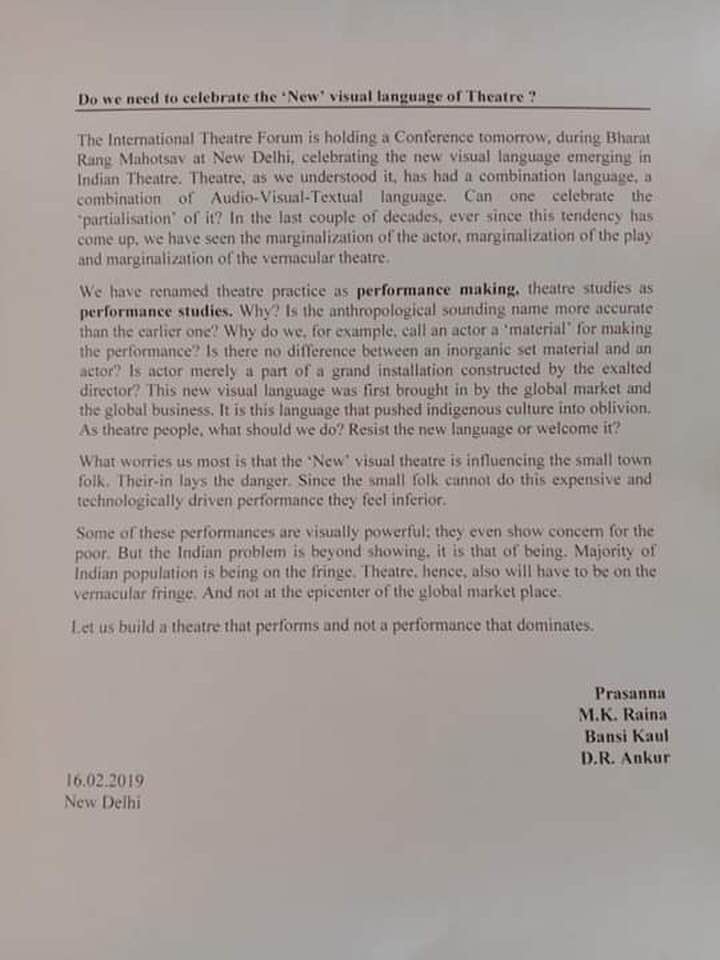
Similarly, in a panel discussion on ‘New visual language in Theatre, organized by World Theatre Form at NSD, on February 17, 2019. Prasanna is an NSD alumnus, renowned theatre director, and playwright from Karnataka. He asserted his argument very strongly against the ‘new visual language in theatre’ based on economic resources and the availability of resources. He argued that “for me, actors and playwrights are available very easily in my village… set and scenography are much more expansive than actor and script, why new visual language is important in Indian theatre” (World Theatre Forum, 2019), mainly for a country like Indian where Theatre is not in excellent condition. Competing and surviving ninety percent of the practitioner in newly emerging theatre practices is challenging. In his counter replay, Amitesh Grover said, “in respect of the seminar, I am totally against what Prasanna Ji has proposed. I am also a young man and feel discriminated. We are in the moment to historized another moment of history here in the seminar. We do not necessarily have to respect history every time in every seminar… I thank the speakers for doing not having back to the Greek times every time they have to come to the central idea…contemporary is coming from different regions Malayalam, Panjabi, Bangla lots of young people have been mentioned, our young people are working in their town and villages right now with new definitions, new practices, and a new spirit. This is a moment to understand these changes” (World Theatre Forum, 2019).

Prasanna and many theatre personalities such as M. K. Raina, Bansi Kaul, and D. R. Ankur come with an augmentative letter against the celebration of ‘new visual language in theatre’ The role of technology and other digital techniques is also being questioned, especially in light of the digital chasm in India.

(The letter was posted on the Facebook wall of Indian Theatre Guide on February 18, 2019)

The above letter has shown the fear that Indian Theatre might be appropriate by a few creative metropolitan theatre-makers. Alternatively, the future of Indian theatre-going far beyond what they thought of. They wrote, “what worries us most is that the ‘New visual theatre’ is influencing the small-town folk. Their-in lies the danger. Since the small folk cannot do this expensive and technologically driven Theatre, they feel inferior.” (Prasanna, 2019). Many theatre directors are still debating the ‘use of digital media in theatre,’ question of ‘live and mediatized,’ ‘virtual vs. physical scenography’ in ‘physical theatre’ and performance space. These questions will be necessary for people who do not have technological accessibility. Indeed, it is not the debate of just new visual language; it is a generation debate. Prasanna, D. R. Ankur, M. K. Raina, and Bansi Kaul have trained in his advocating medium, but time has changed. Someone can go with anti-digital media practices, but new emerging practices cannot be negated.

The Covid19 crisis partially wipes or blurs the previous discussion’ digital media in Theatre or Theatre without digital media’ and adds a fresh significant angle to the ongoing debates’ Theatre through digital media.

The past year has brought changing situations to the performance scene. The impossibility of rehearsing and accomplishing to live spectators has forced performers to investigate new replacements. This has affected both the aesthetics of performance-making and the professional practices of performance-makers. Changes in formats have created new ways of reaching spectators with ever-increasing engagement with various screen-based technology and digital platforms. The new practices have significantly transformed live performances, adapting to new working methods and resulting in resourceful, imaginative replacements and differences. Recognizing the features of these changes will highlight pioneering directions for the future of live performance. This involves developments in the relationship between Theatre and film, offering digital innovations within liveness that this paper attempts to identify and analyze. The aim is to identify and analyze the transformations and generate new conversations among artists and theoreticians. 

The performing arts are vulnerable for the reason that much of the sector depend on live engagement with groups of people in a central space: performers are nearby when sharing a space, and actors and crew members share backstage areas; dressers, make-up artists, props managers, and stagehands all work together to create a live performance. Some modes of live performance might require one-on-one engagement with an audience member or necessitate a transgression of the boundary between audiences and performers. Sound and lighting booths are generally small, enclosed spaces where social distancing is almost impossible.

Embodied engagements and visceral exchanges that foreground the sensory are central to the performing arts. The kind of attention we pay to a theatre piece and our attention to online viewing content is different. Whether watching a performance or performing, those who share the space are not just in space; their interrelationship shapes the shared space. This shaping of shared space and associated embodied exchanges are at the heart of the challenge to reimagine the performing arts in the context of COVID-19.

Theatre and performances locally and abroad make some pre-recorded content available online at no charge or through paid ticketing. However, it is apparent that recorded performances – no matter how well they are done – remain live shows that were recorded. The “languages” of Theatre and film and digital media are different, and so are the positioning of the audience and experiences of immersion in each medium. Augmented performances, mixed-reality works, and works that use virtual reality are developing exciting languages. Such performances still require bodied interaction and some form of shared physical space between audiences and performers.

The recent decades have evidence of a significant shift from physical to digital in the communications field. The digital medium emerged as a powerful medium with special chartists such as quick, interactive, hypermedium, two-way communication, freedom to excess, shear, easy to reach, etc. The digital medium provides humans a systematic use, excess of digital resources globally. In this practice, the question of space has radically transformed. It has been noticed that the performing or theatrical space has vanished from the practices due to the Covid19 lockdown: this restriction converted personal and private spaces to theatrical or performing spaces. Many theatre and performance makers develop a soft architecture or soft space to execute their works.

The paper will draw fresh insights and examples from the recent work ‘Look here, this is your machine. Get in!’ (2020) in an online Serendipity Festival curated by Kai Tuchman and Anuja Ghosalkar on Mozilla Hub. It will be a good idea to briefly introduce the project and artist before going to the analysis. Kai Tuchman is a German-based director, dramaturge, and academician. The concept of documentary theatre practices strongly influenced his work. He constantly attempts to challenge the concept of documentation. He is working in collaboration with many national and international artists. He performed and exhibited his works in Hong-Cong, China, Paris, New York, etc. In his recent project, ‘Look here is your machine. Get in!’ collaborated with Anuja Ghosalkar and curated in virtual Serendipity Arts Festival 2020. Anuja Ghosalkar is a Bangalore-based actor, writer, and director. She is the originator of the Drama Queen theatre group, which focuses on documentary theatre, personal histories, and archives to extend the idea of Theatre to create audacious work. The company’s debut show, Lady Anandi, was written while she was an artist-in-residence at Art Lab Gnesta, Sweden. In the past, Anuja has worked as a program officer at India Foundation for the Arts. Through a Sarai grant, she documented the oral narratives of her grandfather, the oldest living make-up artist in India. In her recent work as a curator, she curated ‘Look here is your machine. Get in!’ 2020.

The project ‘Look here is your machine. Get in!’ is a part of the Serendipity Arts Festival – 2020. The festival was organized on a digital platform called ‘SA virtuality’, ‘The Mozilla-Hub’, because of the Civid19 Pandemic. Curators Kai and Anuja have created a “software architecture” (Wolf, 1992, p. 42) (soft architecture) according to the demand and concepts of the collaborative artists. The project was based on German theatre activist Bertolt Brecht’s radio play ‘Lindbergh’s Flight.’ The curators invited artists and educators to document the moment we tend to live in by asking them to investigate Brecht’s experience, especially the intersection of society, art, and technology. Their responses may represent a new archive of the 269 days of the Pandemic (from the Annunciation, the first day of containment, to December 16, the day of the project’s primaries) and its effects on the public sphere in general on our culture and our policy.

With this invitation, curators Ghosalkar and Tuchmann continue exploring the theater’s precise relationship with real-world events. The nine works of “Look, here is your car. Enter “are halfway between the discourse of antipathy, pessimism, and the need for transhuman improvement.” Digital technology is only formed as a necessary agent within the fundamental plane to imagine survival. Whatever technologies gain, this imagination is at the heart of all virtuality. The Unique Virtue appears to be tech-hyped, but it is not completely so, so it is on the other side of the screen and eye experiences. It is the way of thinking, associating the angle to our being, that is to say, and has been perpetually in co-evolution with machines and non-human organisms. The Serendipity used a novelty technology called ‘SA Virtual.’ The SA reality extends the foundation’s focus on the recent crisis. It has the potential to explore its digital offering. The idea immerged from recognizing the internet-based media as a common ground for daily interaction (such as Facebook, WhatsApp, Instagram, tutor, google-meet, zoom, etc.) in a rapidly changing world. A website called Think Right. Me has written about this development. “However, continuing with the series of digital contributions from Serendipity Arts Foundation, SA Virtual will answer to the internet and its big role in linking people from across the world and combining its offerings that binds us. The SA Virtual will turn to the internet as a site in order to forge meaningful artistic collaborations that are hinged on the innovative integration of the arts and the digital space, aiming to foster an increasingly open and accessible arts community” (Right.Me, 2020). This internet-based virtual platform provides a feature to explore and experiment with different activities such as curated projects, performances, workshops, exhibitions, talks, engagement-based initiatives, and discourse around the arts.

Under the curatorial works of Kai and Anuja, many artists have collaborated, such as technical designers Gavati Wad is, and artist/filmmaker Alisagar Dhariwala. The performance, Theatre, and installation artists are Amitesh Grover, A. Mangai, Ayesha Susan Thomas, Ranjit Kandalgaonkar, Soumyabrata Choudhury, Venket Srinivasan, Yalgaar Saunskrutik Manch, Zhao Chuan, and Zuleikha Chaudhari with their creative works. The project has been exhibited on the platform called Mozilla Hub, and they provide essential information and instruction to navigate the artworks on zoom. Then they guided spectators to the hub. The spectator must create their avatar with a name before interring in the virtual exhibition lobby. The lobby was connected with nine different rooms for every artist. The room was designed according to the nature and demand of the artwork. Outside the room and in the lobby displayed concept notes of the works. Diverse activities were happening simultaneously: virtual exhibition, podcast, virtual performance, and Theatre. Here, the paper only focuses on the theatre ‘The Migrant Walk’ by Dr. Soumyabrata Choudhury. ‘The Migrant Walk’ work was curated in a proper virtual proscenium theatre. There was a flat (two dimensional) 2D screen on the stage. Avatar could go around the screen. Pre-recorded video of the products exhibited in loops on the screen.

Whenever any spectator enters the proscenium (Choudhury’s room), the video starts from the beginning; they have access to control the volume on the screen. Anyone can get the sense of proscenium architecture and the screen perspective of proscenium architecture. The architecture was (three-dimensional) 3D and somehow immersive, but the artworks were simple flat 2D. This creates a kind of contradiction between the artwork and architecture. Alternatively, in other words, the artworks were statics, and the architecture was dynamic. For instance, architecture sims like there was a large screen inside a 3D virtual architecture. For instance, in Ameetesh Grover’s work, from a distance, they have a sense of depth within the character and between the character and the wall. However, when you move near to the character, it is again a 2D flat character.

We have had powerful memory of offline physical Theatre, which always creates a sense of Adolphe Appia and Garden Craig’s idea of “depth and 3D” (Remport, 2020, p. 102) experience. It is also the main characteristic of Theatre, which is distinguished from cinema. Spectators and performers share a common space for performing and watching; the audience has all possibilities to appreciate or decrease the actor/performer while performing. When they enter the theatrical space, they are responsible for behaving like an audience until the show ends, which is a performative character. Sometimes, Theatre triggers our five senses, especially in Dr. Anuradha Kapur and Deepan Sivaraman. In a Kapur play, Virasat (2003), her character cooked rice, vegetable, and many other foods. The smell of cooking was spared in the auditorium after the cooking actors served to the spectator to test the food. The test, smell, and touch are as crucial as senses only activated in physical Theatre.

Similarly, Deepan Sivaraman’s play Ubi Roy () created a concentration camp with spick wire. One’s audience enters the performance space they were not allowed to excite without ending the production. The audience was very close to the performance. In the performance, Sivaraman put fire on stage, and the audience could also feel the heat of the fire. Abhilash Pillai’s production Thulam (…) circus, as the audience able, see a kind scale of vertical and horizontal scenography, which is only possible in the circus tent. Camera lenses are not capable of capturing that scale in such a ratio. Theatre is not just audio-visual arts; it creates a kind of sensory relationship with the audience, which is still lacking in the newly developed online Theatre.

The curatorial work of Kai and Anuja ‘Look here is your machine. Get in!’ much closer to video games instead of Theatre. When I (as an audience) entered Choudhury’s room, ‘The Migrant Walk’, it was like watching a film on a 2D flat screen. It somehow lacks the eeriness of being in the physical presence of the art. It was not immersive as an audience of online theatre/performance/installation because ultimately, the screen and controlling key always reminded me it was a virtual theatre, and I am not with the fellow audience to feel the tangible things when you are in the room. As an audience, you are not anymore a theatre audience; you are a player of a video game you do not have such responsibility to behave like an audience. You have limited programmed freedom (programmers or curators have controlled everything) to roam around the architecture or one room to another.

In the past two years, theatre-making also has changed radically. Many of the actors/performers are performing without a director or co-actor because unavailability of rehearsal space due to Covid19. They are exploring limited resources; they convert personal space into a performance space and use basic or natural lights to explore their aesthetics greed. Directors do not have access to the auditorium and other theatrical equipment. The maximum online ‘live’ Theatre I have seen in the last two years looks very basic in the construction, such as set, light, costume, or overall scenography. I found it interesting that ‘theatre is hanging between past and future’ or digital and physical. They are adopting new media technology, but they also want to save the basic essence of Theatre. The audience is one of the significant elements for the actor; they draw energy from the audience and vice-versa; this is known as the giving and take relationship. The system and other components of Theatre create immersive Theatre. The scenographer’s works shifted to the cinematographer. Now, everything an audience can see is guided by the camera’s perspective.

As a researcher, it is challenging to locate Theatre in Theatre as genera, cinema, video installation, and video game. Sometimes it seems like what Vivan Sundram (a painter, sculptor, and curator) called ‘twinned genre’ (Sundram, 2015) and Something between two or more than two, what Geneva Scully cited ‘Tom Romano’ in the articulation of “multigenre” (Scully, 2008) in his article ‘Considering Alternatives: Multigenre Literature and Multigenre Writing’, Romano defines ‘multigenre’ writing as “composed of many genres and subgenres, each piece self-contained, making a point of its own, yet connected by themes or topic and sometimes by language, image, and contents” (Scully, 2008). Many theatre personalities have claimed that a theatre is a hybrid form of arts; it can adapt to anything. However, I argue that in the maximum case, adopters overcome adoptable, but in this case, it is different. Theatre is not adopting new media technology; besides that, technology is adopting Theatre, which is why the online Theatre does not fit under the framework of ‘theatre.’

It is not denied that online Theatre provides a creative platform for artist collaboration, exploration, and exhibition. It has many great fetchers that could also revolutionize the theatre culture in India and the world. This is the first time many young talents have shown their potential through online platforms because they do not have the higher auditorium, light, sound, or other expenses. Many groups exhibited their works on social media, such as Facebook and YouTube, Mozilla-hub, etc., with ten thousand mobile phone cameras. This economic freedom will challenge the superiority of established directors and actors. Secondly, the online Theatre has the protentional to reach the audience in a private space. Now audience does not have to think about traveling kilometers for a watch and sitting for half an hour in the complete audience mode. It is interesting the National Theatre (London) website disclaimer. In this disclaimer, they are displaying that “Unmissable theatre, whenever you want it…The all-new National Theatre Theater at Home is a streaming service offering unforgettable British theatre available to watch anytime, anywhere” (Theatre, 2021) . Now, an individual could watch a show while traveling, eating, or doing other work, or they can save it for later to watch according to their convenience. The National Theatre, London, and other companies are giving a subscription to their audience, like Netflix, Amazon Prime, etc., monthly and yearly to watch the products globally. This innovative idea has/is replace/ing the previous practices to influence the audience to come auditorium in a particular date and time; now, it is just the opposite, Theatre and auditorium (soft architecture) is reaching an audience without any date and time boundation.

Conclusion:

Online Theatre or digital Theatre has become a significant otherwise ‘theatre’ vanished from the people’s consciousness in the last two years. Through digital technology and theatre-makers, there is no doubt that another artist creates numerous artistic and creative possibilities during the lockdown. The digital Theatre in India is in a very premature stage and has much to explore. The digital Theatre gives a new perspective to thinking Theatre through ‘camera’ or computer-generated 2D, 3D animation. Now theatre directors could adopt the language of cinema in theatre-making, such as intimacy, close-ups, sound clarity, and accessibility. It is challenging for theatre-makers to send Theatre to the audience’s personal space with the claim of ‘theatre,’ not video, film, or game.

Many Over The Top (OTT)[1] companies emerged and developed intermate-based applications to exhibit theatrical production on screen. The OTT platforms are still easy to access without any hierarchies of cultural capital in booking an auditorium, publicity, and accessibility of other resources such as rehearsal space, light, and sound. The development will vanish the auditorium’s importance very soon, leading to a radical transformation towards a political and ascetical approach to using space. We have observed that the personal space is becoming performing space and the performing space are vanishing drastically, particularly during Covid19 lockdown, for instance, Amitesh Grover’s ‘The Lost Poet’ (2021), Soumyabrta Choudhuri’s ‘The Migrant Walk’ (2020), and other groups and individuals. Suppose we develop Theatre for looking any shape of leisure from our bedrooms. In that case, the opportunity for the appearing theatre physicality to become completely virtual isn’t always as far-fetched as we can also think. With this in mind, now could be an essential time to recall the blessings and drawbacks at the back of each sort of execution to understand that one cannot wipe out the other.

Indian Theatre still has a lot to think about, debate, and create this digital media-oriented new experience, “new aesthetics” (Bridle, 2021) and “audience reception” (Bennett, 2013). There are still many significant and influential people, (which the article has mentioned above) in contemporary Indian Theatre rejecting this emerging form of Theatre in toto. It means not that we want linear Theatre or single voice, but it should be better to reach a common goal, where new development could be part of our curriculum to understand in greater detail. The debate on online Theatre should come strongly to grasp this development.

Besides all this development, I was a spectator who could not accept online Theatre as a genre of ‘theatre’; it could be performance, video installation, video-game-theatre but not Theatre. It means not that using digital media in Theatre is not a part of a new visual language. We know the Theatre is transformative because it links personal narrative with performance, letting spectators connect with moments of individual moments. Everybody deserves to witness such impactful involvements without perturbing about a price tag or distance. Yet, once the Theatre is digitalized and transmission through the internet, the influence, content, and jobs theatres will vanish. So, as we at present spend more time at home, please take advantage of the profusion of Theatre that is accessible but think of sustenance and be there in live Theatre once all the activities are resumed.

Indeed, the online Theatre cannot be equivalent to the involvement that a live theatre with hundreds packed in an auditorium gives; it is imperative to familiarize ourselves with the environments that mount us. Performers, theatre-makers worldwide that make the medium of theatre flourish, have decided to take this challenge head-on. The fact that social and physical collaboration and interaction are the key apparatuses of the ‘genre’ makes this challenging.

Reference

  1. Anuja Ghosalkar, K. T. (2020, December 20). Look here is your machine. Get in! Retrieved from Serendipity Arts: https://www.serendipityartsvirtual.com/project/look-here-is-your-machine-get-in/
  2. Auslander, P. (2008). Liveness: Performance in a Mediatized Culture. London, New York: Routledge.
  3. Bennett, S. (2013). Theatre Audiences (2nd ed.). London: Routledge.
  4. Bridle, J. (2021, May 06). The New Aesthetic. Retrieved from booktwo.org: http://booktwo.org/notebook/the-new-aesthetic-10/
  5. Burger, J. (1972). Ways of Seeing. London: British Broadcasting Corporation.
  6. Cartledge, S. (2021, April 10). HOW COVID-19 IS RESHAPING THE PERFORMING ARTS. Retrieved from The Theatre Times: https://thetheatretimes.com/how-covid-19-is-reshaping-the-performing-arts/
  7. Coetzee, M.-H. (2020, August 12). Theatre in the time of COVID-19: Should the show go on? Retrieved from The University of Pretoria: https://www.up.ac.za/news/post_2914407-theatre-in-the-time-of-covid-19-should-the-show-go-on-
  8. Dhanao, B. (2015, March-April 25-02). 409 Ramkinkars. (A. K. Vivan Sunderam, Performer) IGNCA and Vivadi, New Delhi, IGNCA, India.
  9. Dhanmanjiri Sathe, P. W. (2020, may 28). Bringing the focus back to the informal sector. Retrieved from The Indian Express: https://indianexpress.com/article/opinion/bringing-the-focus-back-to-the-informal-sector-6430206/
  10. Drama, N. S. (2020). Theatre Performance and Festival – An emerging site for contestation and debate [Recorded by R. Bajaj]. New Delhi.
  11. Geover, A. (2020, December 18). The last Poet. Retrieved from Amitesh Grover: https://amiteshgrover.com/the-last-poet
  12. Mehta, B. (2020, April 13). Covid-19 and the lockdown impact: Estimating the unemployment and job losses in India’s informal economy. Retrieved from The Times of India: https://timesofindia.indiatimes.com/blogs/red-button-day-light/covid-19-and-the-lockdown-impact-estimating-the-unemployment-and-job-losses-in-indias-informal-economy/
  13. Prasanna, M. R. (2019). Do we need to celebrate the ‘new’ visual language of Theatre. New Delhi: Indian Theatre Guide.
  14. Remport, E. (2020). Edward Gordon Craig and W. B. Yeats, 1901–1911: Engaging Turner, Ruskin, Wagner, and Appia. IRISH STUDIES REVIEW, 102.
  15. Right.Me, T. (2020, November 18). LifeStyle. Retrieved from Think Right. Me: https://www.thinkrightme.com/en/live-right/serendipity-arts-foundation-to-launch-a-new-digital-art-called-sa-virtual/
  16. Scully, G. (2008). Considering Alternatives: Multigenre Literature and Multigenre Writing. The Language Arts Journal of Michigan, 40-46.
  17. Sundram, V. (2015, March-April 25 – 02). 409 Ramkinkars. Brochure. New Delhi, Delhi, India: IGNCA and Vivaldi.
  18. Theatre, N. (2021, September 16). Unmissable Theatre, whenever you want it. Retrieved from National Theatre: https://www.nationaltheatre.org.uk/ntathome?__cf_chl_captcha_tk__=pmd_Gum0J_KRqR1ZMWr0m.a4C5oYTMw_zOd8mzzrRq4BTxc-1631781493-0-gqNtZGzNArujcnBszQjR
  19. Wolf, D. E. (1992). Foundation for the Study of Software Architecture. Software Engineering Notes, 17(04), 40.
  20. World Theatre Forum, N. (2019). The new visual language of Theatre. The new visual language of in Theatre. New Delhi: NSD.
  21. It is an online digital platform to reach the audience across the world for showing, exhibiting, performing and curating arts works. ↑

पेरियार ललई सिंह के साहित्य में चित्रित लोक-संघर्ष के आख्यान का अवलोकन-मुकेश कुमार यादव

0

पेरियार ललई सिंह के साहित्य में चित्रित लोक-संघर्ष के आख्यान का अवलोकन

मुकेश कुमार यादव

शोधार्थी हिन्दी विभाग,

लखनऊ विश्वविद्यालय, लखनऊ

devmukesh17@gmail.com

Mobile No. – 9717803691

सारांश

पेरियार ललई सिंह के नाटकों में जाति-व्यवस्था का जो रूप देखने को मिलता है। वह भारतीय पौराणिक साहित्य में उपस्थित आख्यानों से व मौजूदा समाज के उदाहरण को आधार बनाकर कर लिखा गया है। उन आख्यानों में जो लोकसंघर्ष देखने को मिलता है। वह समाज के क्रमिक विकास का हिस्सा है। उनके नाटकों का ऐतिहासिक व समाजशास्त्रीय परिप्रेक्ष्य में इस शोध आलेख में अवलोकन किया गया है।

बीज शब्द: लोक, आख्यान, नाट्य, लोकजीवन, लोक संघर्ष, सामाजिक भेदभाव, जाति व्यवस्था, सबाल्टर्न।

शोध आलेख

हिंदी में ‘आख्यान’ शब्द प्राय: साधारण कथा या वृत्तांत के रूप में ही प्रयोग किया जाता रहा है। यह ‘आख्यान’ शब्द मौखिक परम्परा या श्रुति परम्परा के रूप में विकसित हुआ है। आख्यानपरक काव्यों के अंतर्गत कथा (सत्यवती कथा), चरित (मधुमालती चरित), वार्ता (छिताई वार्ता), दूहा (ढोला मारूरा दूहा), चौपाई या चउपई (माधवानल कामकंदला चउपई), रास (बीसलदेव रास) आदि सभी काव्य विधाएँ प्राप्त होती हैं। काव्य की इन शैलियों में भारतीय अतीत की गाथाएं विभिन्न रूपों में आयी हैं। अतीत की गाथाओं को अक्सर मिथक के रूप में देखा जाता है। आख्यान या मिथक के अर्थ को परिभाषित करते हुए डॉ. अमरनाथ लिखते हैं कि “हिंदी में मिथक के लिए ‘पुरावृत्त’, ‘पुराकथा’ ‘कल्पकथा’, ‘देवकथा’, धर्मकथा’, ‘पुराणकथा’, ‘पुराख्यान आदि अनेक शब्द प्रयुक्त होते रहे हैं।”[1] आख्यानों की सत्ता का प्रमाण सबसे पहले हमें मौखिक रूप से ऋग्वेद में देखने को मिलता हैं। वेदों में संकलित श्लोक अलग-अलग समय में लिखे गए हैं। इसके संदर्भ में यह कहा जाता है कि इसके मंत्रों को पीढ़ी दर पीढ़ी याद करके संरक्षित किया गया था। जिसे श्रुति परंपरा कहा जाता है। वेदों की व्याख्यान प्रणाली के विभिन्न संप्रदायों में यास्क ने ऐतिहासिक संप्रदाय का अनेक बार उल्लेख किया है जिसमें देवों के अधिपति इंद्र के साथ घोर संघर्ष और तुमुल संग्राम का वर्णन इसमें देखने को मिलता है। वेद और पुराण के व्याख्याकारों की दृष्टि में वेदों में महत्वपूर्ण आख्यान विद्यमान हैं। ऋग्वेद में इंद्र तथा अश्विन के विषय में अनेक आख्यान ऐसे मिलते हैं जिनमें इन देवों की वीरता, पराक्रम तथा उपकार की भावना अंकित की गई है। इसके अलावा दानस्तुतियों में अनेक राजाओं के नाम उपलब्ध हैं जिनसे दान पाकर अनेक ऋषियों को उनकी स्तुति में मंत्र लिखने की प्रेरणा मिली। इन स्तुतियों में भी कतिपय आख्यानों की ओर स्पष्ट संकेत मिलते हैं। इस प्रकार हम देख सकते हैं कि आख्यानों में दो वर्गों के बीच होने वाले संघर्ष किस तरह अपने विकास क्रम में विपुल सामग्री रामायण और महाभारत के रचयिताओं को उपलब्ध कराती है। इन्हीं पौराणिक आख्यानों से कथानक लेकर, आख्यानों में मौजूद लोक संघर्ष का विश्लेषण पेरियार ललई सिंह ने अपने लेखन में किया है।

पेरियार ललई सिंह अपने नाट्य लेखन में मिथकीय आख्यानों का चुनाव दलित व वंचित वर्ग में चेतना जागृत करने के रूप में करते हैं। भारतीय समाज में वर्ण-जाति के भेदभाव को मिटाने व शोषित वर्ग के मानवीय अधिकारों के लिए ज्योतिबा फुले, डॉ. भीमराव अंबेडकर, पेरियार ई.वी. रामासामी, चंद्रिका प्रसाद जिज्ञासु, रामस्वरूप वर्मा, बौद्ध भिक्षु महास्थिविर ऊँ चंद्रमणि आदि समाज सुधारकों, चिंतकों ने मिथकीय आख्यानों को आधार बनाकर ( जो हिंदू धर्म ग्रंथ समझे जाने वाली पुस्तकों में संरक्षित हैं) शोषित जनों (सबाल्टर्न) के दृष्टिकोण से उसका अध्ययन एवं विश्लेषण किया है। जिसका प्रभाव हम स्पष्ट रूप से पेरियार ललई सिंह के रचनाओं में देख सकते हैं। पेरियार ललई सिंह (1911-1993) एक मानवतावादी व समाजसुधारक थे। जिन्होंने अपने सार्वजनिक जीवन में समाज के बीच होने वाले सामाजिक (वर्ण और जाति संबंधी भेदभाव), आर्थिक (‘सिपाही की तबाही’ में चित्रित सैनिक का परिवार), शारीरिक (किसान मजदूर नेता जसमा) एवं मानसिक शोषण (एकलव्य, वीर संत माया बलिदान) आदि को होते हुए देखा तो ऐसे तमाम मसलों पर गंभीर अवलोकन, अध्ययन एवं उसकी छानबीन की। सामाजिक भेदभाव के कारणों को जानने के क्रम में वे उस समय के विद्वानों, चिंतकों को सुनने, उनकी संगति करने लगे। इसी क्रम में उपरोक्त चिंतकों के संपर्क में आए।

पेरियार ललई सिंह ने जब यह अनुभव किया कि समाज में, जिसके साथ भी उत्पीड़न या शोषण हो रहा है, वे लोग एक खास वर्ग विशेष से ताल्लुक रखने वाले हैं। इस बारे में वे कहते हैं कि “हमारे आदिनिवासी (पिछड़े, अनुसूचित, आदिम जाति, अल्पसंख्यक व स्त्रियाँ आदि) भाईयों और बहनों का जो आर्य लोग धार्मिक, सामाजिक, आर्थिक, राजनैतिक व दैहिक दोहन-शोषण प्रतिदिन करते हैं। आदिनिवादियों को इस बात का एहसास नहीं होने देते हैं कि तुम्हारा भी कोई मानवीय अधिकार है।”[2] ऐसी स्थिति में शोषण करने वाले लोगों / वर्गों के खिलाफ उन्होंने न केवल आवाज उठाया बल्कि उसके लिए आजीवन संघर्ष भी किया। इसी सिलसिले में वे भारतीय समाज में प्रचलित लोक आख्यानों को आधार बनाकर नाटकों की रचना करते हैं। जिसके माध्यम से उन्होंने यह दिखाने की कोशिश की है कि इन नाटकों के मंचन के द्वारा लोक-संघर्ष से समाज को रूबरू कराया जाए क्योंकि आख्यानों में मौजूद शोषित, प्रताड़ित लोगों का एक बड़ा वर्ग मौजूद है। जिनके अधिकार छीने गए और उनको मूलभूत जरूरतों से वंचित किया गया। उनका मानना था कि मानव समाज में हिस्सेदारी और अधिकार के मसलों पर सभी का बराबर हक है। वे यह भी चाहते थे कि हर मनुष्य राजनीतिक स्वतंत्रता के साथ- साथ सामाजिक रूप से भी स्वतंत्र रहे। “राजनीतिक स्वतंत्रता की आवश्यकता इसलिए होती है कि मनुष्य को सामाजिक स्वतंत्रता हो। मनुष्य, दूसरों की स्वतंत्रता में बाधक न होकर स्वेच्छानुसार खा-पी सके, पहन-ओढ़ सके, चल-फिर सके, मिल-जुल और ब्याह-शादी कर सके। यदि सामाजिक स्वतंत्रता नहीं है तो राजनीतिक स्वतंत्रता का कोई अर्थ नहीं रह जाता… इसलिए सामाजिक समता और सामाजिक स्वतंत्रता ही हमारा मुख्य उद्देश्य होना चाहिए। राजनीतिक स्वतंत्रता तो उसमें सहायक होने के कारण ही वांछनीय है।”[3] पेरियार ललई सिंह ने अपने साहित्य सृजन के लिए जिन कथानकों का चुनाव किया है, वे सब लोक स्मृति के जरिए आख्यान या कहानी के रूप में अभिव्यक्त हुई हैं। उन लोक आख्यान के कथानक को अलग-अलग समय एवं संदर्भों में घटित घटनाओं से लिया है।

पेरियार ललई सिंह ने पेरियार ई. वी. रामासामी से उनकी द्वारा लिखित ‘रामायाना : ए ट्रू रीडिंग’(1968) को हिन्दी भाषा में अनुवाद करने के लिए अनुमति मांगी। अनुमति मिलने के बाद राम आधार से हिन्दी में अनुवाद करवाया और अपने ‘अशोक पुस्तकालय’ प्रेस से ‘सच्ची रामायण’(1968) नाम से प्रकाशित किया। यह पुस्तक संस्कृत महाकाव्य रामायण के उन घटनाओं पर प्रकाश डालती है। जिसमें राम को रावण, बालि, शंबूक जैसे प्रभावशाली व्यक्तियों से लड़ाई करनी पड़ी। इसके अतिरिक्त तीन ऐसे नाटक लिखे जिसके कथानक पुराण, महाभारत एवं रामायण से लिए गए हैं। उन नाटकों में क्रमशः ‘नागयज्ञ’(1966) एकलव्य’(1968) तथा ‘शंबूक वध’(1962) है। इसके अलावा उन्होंने एक अन्य नाटक ‘अंगुलीमाल’(1964) भी लिखा है, जो अंगुलीमाल के चरित्र एवं उसके स्वभाव, स्त्री-पुरुष संबंधों पर लिखा गया है। अंगुलीमाल बौद्धकालीन एक किवदंती है जिसको आधार बनाकर ‘अंगुलिमालीय महायान सूत्रम’ लिखा गया है। भारतीय सामंतयुगीन समाज की एक घटना जो भाटों के लोक आख्यान में प्रचलित है, को आधार बनाकर ‘संत माया बलिदान’(1960) नामक एकांकी भी लिखा है। पहले तीन नाटकों का कथानक जहां से लिया गया है, उन आख्यानों में आर्य-अनार्य, सुर-असुर संघर्ष, सत्ता एवं शिक्षा के अधिकार से वंचित वर्ग, स्त्री-पुरुष संबंध, युद्ध-नीति जैसे प्रमुख बिन्दु उभरकर सामने आते हैं। उन आख्यानों में मानवीय पक्ष भी उपलब्ध हैं। जिसे ‘विश्व मैत्री भावना’ के रूप में देखा गया है। मानव के विकास क्रम में वर्ग की अवधारणा अभी हाल ही की समझी जाती है, जबकि पेरियार ललई सिंह अतीत की कहानियों को समेटे आख्यानों में भी वर्ग एवं उनके मध्य होने वाले संघर्ष को इन नाटकों के माध्यम से प्रस्तुत करने का प्रयास किया है। इन लोक आख्यानों में मौजूद दो तरह के लोगों की वैचारिकी वर्ग-संघर्ष का आधार बनती है।

सिपाही की तबाही (1946)

पेरियार ललई सिंह वर्ग संघर्ष संबंधी आख्यानों के बारे में जानना तब शुरू किया जब वे ग्वालियर रियासत या राज्य के लिए युद्ध लड़ने के लिए ‘हाई कमांडर’ के रूप में नियुक्त हुए। उसी दौरान उन्होंने शासक एवं सैनिक के मध्य हुए संघर्ष को देखा। संभवतः इसी संघर्ष की अभिव्यक्ति ‘सिपाही की तबाही’ के रूप में हुई। इस रचना को अपूर्ण माना जाता है। ‘सिपाही की तबाही’(1946) लिखने से पहले वे यह महसूस करते हैं कि वर्तमान राजा की सेना में जो सैनिक काम कर रहे हैं उनका शोषण किया जा रहा है। जिसके विरुद्ध सैनिकों को एकजुट करके उन्होंने मोर्चा खोला तथा हड़ताल करवायी। जिसके कारण उन्हें बंदी भी बनाया गया। संघर्ष एवं शोषण से जुड़े तथ्यों की जब उन्होंने तहकीकात की तो पाया कि इसका संबंध इतिहास की जड़ों से जुड़ा हुआ है। पेरियार ललई सिंह ने शोषण की उस स्वानुभूति को इस नाटक के माध्यम से व्यक्त किया है। वर्ग संघर्ष का सिद्धांत उनके लेखन में कहीं न कहीं कार्ल मार्क्स के विचारों से प्रेरित होकर आया है। जिसका जिक्र वे अपने एक साक्षात्कार में करते हैं। वे कहते हैं कि “मैं समाजवाद को नहीं मानता। समाजवाद तो स्वार्थवाद है। साम्यवाद के बारे में मेरे निजी विचार भी कुछ पृथक हैं, क्योंकि शोषितों की क्षतिपूर्ति वहाँ भी पूर्णतः सम्भव नहीं है। फिलहाल साम्यवादी तरीके से समता का मार्ग अवश्य प्रशस्त किया जा सकता है।”[4] यहां पर यह उल्लेखनीय है कि साम्यवाद की स्थापना वर्ग संघर्ष पर ही आश्रित है। भारतीय समाज में वर्ग, जातीय रूप में मौजूद है। इसी कारण पेरियार ललई सिंह के ऊपर मार्क्स के साथ-साथ अम्बेडकर, पेरियार का प्रभाव स्पष्ट रूप से देखा जा सकता है। अतः इससे स्पष्ट है कि वे समाज में साम्यवाद की स्थापना वैज्ञानिक समाजवाद के माध्यम से करने के पक्ष में थे। वर्ग संघर्ष की तहकीकात करने के क्रम में भारत के अतीत या आख्यानों को खंगालते हुए उसका पुनः सृजन करते हुए देखे जा सकते हैं।

वीर संत माया बलिदान (1960)

पेरियार ललई सिंह के अन्य नाटकों में भी वर्ग संघर्ष के बीज बिन्दु मौजूद हैं। ‘वीर संत माया बलिदान’ की भूमिका में वे लिखते हैं कि “वीर सन्त माया बलिदान भाटों द्वारा वर्णित एक सच्ची कहानी है, जो आज भी अपनी भग्नावशेष जीर्ण-शीर्ण दशा से स्वतः प्रमाणित है।… कुछ भाटों का मत है कि ‘वीर सन्त माया’ का बलिदान नरमेध यज्ञ के ढंग पर हुआ, फलस्वरूप वरुणदेव ने नीचे से पाताल तोड़कर तालाब को पानी से लबालब भर दिया। यह मत अन्धविश्वास पर आधारित होने के कारण अमान्य है। दक्षिण भारत में उस समय ऐसी बलि प्रथा प्रचलित थी।”[5] इस नाटक में पाटण (गुजरात) के सामंती समाज का चित्रण महाराज सिद्धिराज के माध्यम से किया गया है। जो भोग, विलास की प्रवृत्ति से घिरा हुआ है। सिद्धराज (सामंत), संत माया (बौद्ध भिक्षु), जसमा (मजदूर नेता), केशोमाधो (राज पुरोहित) के माध्यम से ब्राह्मण और बौद्ध संप्रदाय के मध्य होने वाले वैचारिक मतभेद को चित्रित किया गया है। मंदिरों में शूद्र वर्ग के लोगों का प्रवेश, मुखिया द्वारा शूद्र संत माया से मंदिर में आरती कराना जिसके परिणामस्वरूप सवर्ण एवं शूद्रों के मध्य संघर्ष की स्थिति बन जाती है। इस नाटक में वर्ग संघर्ष की दूसरी स्थिति शासक वर्ग एवं तालाब खोदने वाले मजदूरों के मध्य हुए संघर्ष में देखने को मिलती है। संत माया ब्राह्मण धर्म से खिन्न होकर बौद्ध धर्म ग्रहण कर लेता है। मानव समाज में आए अकाल की समस्या से पीड़ित गरीब, मजदूर, शिल्पकार के हित के लिए संत माया अपना बलिदान दे देता है।

शंबूक वध (1960)

भारतीय लोक मानस में राम की कहानी साहित्य के अलग-अलग रूपों से होती हुई नाटक में आयी है। नाटक की परम्परा लोक संस्कृति के गीतों, नृत्यों, वाद्ययंत्रों के समन्वय से विकसित हुई है। ‘लोक’ शब्द से अभिप्राय उस ग्रामीण अंचल से है जिसमें राम की कहानी को ‘रामलीला’ के माध्यम से दिखाया जाता है। ग्रामीण अंचलों में यह कहानी कब पहुंची इसका स्पष्ट उत्तर मिल पाना मुश्किल है ? लेकिन जब लोक की स्मृतियों को खंगाला जाता है तो उसमें से कुछ अविस्मरणीय कहानियां मिलती हैं। जैसे शंबूक वध, देवासुर संग्राम, उर्वशी-पुरुरवा संवाद आदि। शंबूक वध से जुड़ी कहानी में शिक्षा व्यवस्था से जुड़ें मानवीय अधिकार का सवाल उभर कर आता है। जाति व्यवस्था इसके पीछे क्या भूमिका निभाती है ? क्या कारण रहा है इसका रूप उस समय खूब फलता-फूलता है ? इन्हीं सवालों को उठाया गया है, ‘शंबूक वध’ नाटक में। ‘शम्बूक वध’ नाटक को छापने के मुख्य उद्देश्य को बताते हुए वे कहते हैं- “नाटक के छापे जाने की पहली मंशा है अधिकार वंचित शूद्र व महाशूद्र अपने अधिकार समझें। मांगे! छीने। इसी स्थिति के कारण मैं बार-बार कहता हूँ कि ‘अधिकार माँगे नहीं छीने जाते हैं!’ और ‘सामाजिक अपमान गरीबी से अधिक खटकता है!’। दूसरी मंशा, इस देश के सवर्ण हिन्दू शूद्रों व महाशूद्रों को उनका मानवीय अधिकार सौंप दें। तीसरी मंशा, सरकार के लिए कड़ी चेतावनी है कि उसने यदि उन्हें प्रत्येक प्रकार के मानवीय अधिकार न दिलाए तो इस देश में गृह युद्ध का संकट सदैव बना रहेगा।”[6] इस नाटक का कथानक वाल्मीकि रामायण से लिया गया है। इस नाटक में शंबूक ऋषि को उस समय के शिक्षा से वंचित समुदाय के शिक्षक, तपस्वी एवं संत पुरुष के रूप में देखा गया है। आश्रम पद्धति पर ही वे अपने शिष्यों को समाज के अच्छे-बुरे कार्यों से अवगत कराते थे साथ ही उन्हें नैतिकता तथा अनैतिकता का पाठ पढ़ाया करते थे।

ऋषि शंबूक जिस दौर में एक शिक्षक की भूमिका निभा रहे थे। उस दौर में ब्रह्म का ज्ञान व जानकारी केवल ब्राह्मण वर्ग के लोगों के पास थी या फिर अन्य वर्ण के लोग भी थे, इसकी जानकारी हमें पुराणों में आए तमाम ऋषियों से मिलती है। ऋषि विश्वामित्र जो कि क्षत्रिय वर्ण से संबंध रखते थे आगे चलकर ब्राह्मण हो गए। वे एक खास वर्ग के लोगों को शिक्षित करते हुए पाए जाते हैं। ऋषि वशिष्ठ ब्राह्मण थे। वे भी अपने ही वर्ग विशेष के लोगों को शिक्षित करते हुए पौराणिक आख्यानों में चित्रित हैं। ब्राह्मण वर्ग की शिक्षा व्यवस्था जब उन्हीं के वर्ग तक सीमित है तब यह स्पष्ट है कि एक वर्ग ऐसा भी था जो इससे वंचित था।

नागयज्ञ (1966)

लोककथा महाभारत के पात्र एवं घटना को आधार बनाकर हिन्दी साहित्य में अनेकों ग्रंथ लिखे गए हैं। उन्हीं में से एक है ‘अंधा-युग’(1954)। जिसकी व्याख्या द्वितीय विश्वयुद्ध के बाद उपजे समस्या को रेखांकित करने के संदर्भ में की जाती है। उससे निजात पाने के लिए अतीत की घटनाओं को उदाहरण स्वरूप देखा जाता है। युद्ध की समस्या महाभारत की घटना के समय भी थी और द्वितीय विश्वयुद्ध के समय भी। यह समस्या भविष्य में भी संभावित है। पेरियार ललई सिंह द्वारा लिखित नाटक ‘नागयज्ञ’ भी युद्ध से निजात पाने की अवधारणा से जुड़ा हुआ है और यह दो तरह के विचार या वर्ग की ओर संकेत करता है। यह युद्ध एक तरह से दो जातियों का युद्ध है जिसके कारण ‘नागयज्ञ’ नाटक में ‘नाग’ शब्द पर विशेष जोर दिया गया है। यह एक जाति विशेष के रूप में आया है। नाग जाति से जुड़ी अनेकों जातियां अभी भी महाराष्ट्र एवं देश के अन्य हिस्सों में मौजूद हैं। मिथकीय आख्यानों में आये कबीले, जाति का जो उल्लेख हमें प्राप्त होता है। उनमें किरात, निषाद, नाग का उल्लेख बहुत बार मिलता है। लेकिन नाग कौन हैं? इसकी सच्चाई क्या है ? चाहे यह सच हो या नहीं, यह ऐसा ही तथ्य है, तथा हिंदू इसमें विश्वास करते हैं। इस प्रश्न का समुचित उत्तर हमें डॉ. भीम राव अंबेडकर के इन कथनों से मिलता है। वे कहते हैं- “प्राचीन भारत के इतिहास से पर्दा हटाया जाना चाहिए। इस उद्घाटन के बिना प्राचीन भारत इतिहास-विहीन रह जाएगा। सौभाग्य से बौद्ध साहित्य की मदद से प्राचीन इतिहास को उस मलबे से खोदकर निकाला जा सकता है, जिस मलबे के नीचे ब्राह्मण लेखकों ने पागलपन में उसे दबाकर रख दिया है। बौद्ध साहित्य से बहुत हद तक मलबा हटाने व उसके नीचे छिपे तत्व बिल्कुल स्पष्ट रूप से देखने में मदद मिलती है। बौद्ध साहित्य बताता है कि ‘देव’ मानव समुदाय से थे। बहुत से देव बुद्ध के पास अपनी शंकाओं के समाधान तथा कठिनाइयां दूर करने के लिए आते थे। यदि देव मानव नहीं होते तो ऐसा कैसे हो सकता था ? इसके अलावा बौद्धों का प्रामाणिक साहित्य नागों से संबंधित जटिल प्रश्न पर समुचित प्रकाश डालता है। यह कोख से पैदा हुए नाग और अंडे से पैदा हुए नाग में भेद बताता है, और इस प्रकार यह स्पष्ट करता है कि ‘नाग’ शब्द के दो अर्थ होते हैं। इस शब्द का मूल अर्थ मानव समुदाय के लिए प्रयुक्त हुआ है। इसके अलावा, असुर भी राक्षस नहीं हैं। वे भी जन-विशेष मानव ही हैं। शतपथ ब्राह्मण के अनुसार, असुर सृष्टि के निर्माता प्रजापति के वंशज थे। वे नरक-दूत कैसे बन गए, यह पता ही नहीं है। लेकिन यह तथ्य लिपिबद्ध है कि वे पृथ्वी पर आधिपत्य करने के लिए देवों से लड़े, जिन्हें देवों ने जीत लिया और जिन्हें अंततः समर्पण करना पड़ा। यह बात स्पष्ट है कि असुर दैत्य नहीं, बल्कि मानव परिवार के सदस्य थे।”[7] नाग जाति एवं उनके पर्व ‘नाग पंचमी’ के इस आख्यान को द्रविड़ सभ्यता से जोड़कर देखा जाता है। इसका उल्लेख विमलेश्वरी सिंह अपनी पुस्तक ‘नागवंश’[8] में विस्तार से करती हैं। यहां पर आर्य एवं अनार्य (द्रविड़) दो ऐसे वर्ग देखने को मिलते हैं। जिनके मध्य हुए संघर्ष का आख्यान विभिन्न ग्रंथों में आया है।

नाग जाति से जुड़े आख्यान की यह कहानी महाभारत युद्ध के बाद की है। जब पांडव परीक्षित को साम्राज्य संभालने की जिम्मेदारी देकर स्वर्ग की तरफ चले गए। इन्हीं परीक्षित को तक्षक नामक नाग ने जिस युद्ध नीति के सहारे मारा था। उसी के प्रतिउत्तर में जन्मेजय द्वारा हत्या का बदला लिया जाता है। इसी कथानक को आधार बनाकर जयशंकर प्रसाद ने भी ‘जन्मेजय का नागयज्ञ’(1926) नामक नाटक लिखा है। युद्ध से जुड़ी लोक आख्यानपरक कहानियों की चर्चा युद्ध में लड़ने वाले योद्धाओं के बीच आम बात समझी जाती है। इस तरह के युद्ध दो वर्ग की परिकल्पना को पुष्ट करते हैं। इस नाटक में युद्ध से शांति पाने के लिए ‘विश्व मैत्री भावना’ का वरण तो किया है लेकिन युद्ध हो जाने के बाद। पेरियार ललई सिंह युद्ध, राजनीति, छल-कपट, ईर्ष्या, बदले की भावना के बीच लोक संघर्ष की इस कहानी को व्यक्त करते समय कुछ प्रतीकों का निर्माण करते हैं। जिसे ‘जन्मेजय समिति’, ‘कश्यप समिति’ के रूप में देखा जा सकता है। इन समितियों के बारे में नाटक की भूमिका में वे लिखते हैं- “दृश्य 6 में वर्णित ‘उतंग समिति’ का आजकल के शब्दों में मतलब ‘गांधीवाद’ है, जो अब तक छुआछूत भी नष्ट नहीं कर पाया है। ‘कश्यप समिति’ का मतलब है ‘हिन्दूवाद’, जो आज के विज्ञान युग में भी ‘लकीर का फकीर’ है। ‘जन्मेजय समिति’ का मतलब ‘कुर्सीवाद’ है, जो शोषितों, दलितों, पिछड़ों, पीडितों और अल्पसंख्यको के रोटी-रोजी, मकान, बच्चों की पढ़ाई-लिखाई, दवा-दारू तथा उनकी इज्जत की समस्या भी हल नहीं कर पाया है।”[9]

एकलव्य (1968)

महाभारत भी एक युद्ध की कहानी है। जिसकी गूंज हमारे लोक साहित्य में भी सुनाई देती है। हालांकि प्रभाकर श्रोत्रिय ‘भारत में महाभारत’ में इससे इत्तेफाक रखते हैं। उनका मानना है कि महाभारत युद्ध की कहानी नहीं है। महाभारत के तमाम प्रसंगों के बीच ‘एकलव्य’ से जुड़ा एक आख्यान है। एकलव्य नाटक में निषाद जाति का उल्लेख हुआ है। इस नाटक एवं अन्य आख्यानों में यह जाति शृंगवेरपुर में राज्य करती थी। निषाद राज हिरणधनुष का पुत्र ‘एकलव्य’ गुरु द्रोण से धनुर्विद्या का गुण सीखना चाहता है। लेकिन गुरु द्रोण अपने ब्राह्मण वर्ग के हित के अतिरिक्त किसी भी तरह का ज्ञान किसी को नहीं देना चाहते थे। उनके द्वारा ‘एकलव्य’ को जब सिखाने से मना कर दिया जाता है तो वह उनकी एक आभासी मूर्ति बनाकर उसके सामने अभ्यास करके ऐसा गुण सीख जाता है जिसके माध्यम से वह किसी को भी युद्ध में हरा सकने की क्षमता रखता है। लेकिन एक घटना ने एकलव्य द्वारा अर्जित किए गए ज्ञान को चकनाकूर कर दिया। वह घटना यह है कि गुरु द्रोण ने अपने आभासी मूर्ति से सीखने के कारण गुरु दक्षिणा के रूप में एकलव्य का अंगूठा ले लिया। यह घटना गुरु-शिष्य परम्परा, दक्षिणा (शिक्षा शुल्क) के नैतिकता-अनैतिकता के सवाल को खड़ा करता है। इस संदर्भ में पेरियार ललई सिंह की टिप्पणी देखने योग्य है। वे कहते हैं कि “यह नाटक इस मतलब से छापा गया है कि एक ओर तो छुआ-छूत न मानने का कानून बन गया है, मगर दूसरी ओर शूद्र-विरोधी पुरानी सड़ियल भारतीय सभ्यता वाली स्मृतियाँ, रामायण, गीता व महाभारत आदि धनवानों और विदेशियों के खर्चे से सस्ती कीमत में हम लोगों को दिमागी गुलाम बनाने के लिए घड़ाधड़ छप रहे हैं।”[10] उनके इस कथन से दो वर्ग के मध्य होने वाले भेदभाव को देखा जा सकता है। एकलव्य नाटक में हम देख सकते हैं कि द्रोण एवं उनके शिष्य जिस वर्ग विशेष से ताल्लुक रखते हैं। वह एक दायरे में सीमित है। उनका दृष्टिकोण एक वर्ग विशेष के हित तक सीमित है। जो वंचित वर्ग को शिक्षा देने के पक्ष में नहीं है।

अंगुलीमाल (1964)

गौतम बुद्ध के समय में होने वाले लोक संघर्ष, समाज की शिक्षा प्रणाली, सामाजिक वर्ण भेद, स्त्री-पुरुष सम्बन्धों, नैतिकता-अनैतिकता के मुख्य बिंदुओं को ‘अंगुलीमाल’ नाटक में चित्रित किया गया है। माणवक (अंगुलीमाल) पर गुरूपत्नी शैलेन्द्री के साथ ‘व्यभिचार’ करने का आरोप लगता है। जिसके दंड स्वरूप एक हजार व्यक्तियों की हत्या करके उनकी अंगुलियाँ लाने के लिए कहा गया। इस नाटक में अंगुलीमाल पर व्यभिचार का आरोप लगने के बाद दो-तीन बिंदुओं पर गौर करने की जरूरत है। पहला, गुरुपत्नी शैलेन्द्री माणवक के साथ अपनी काम इच्छा को प्रस्तुत करती है लेकिन सामाजिक मान्यताओं को देखते हुए माणवक इंकार कर देता है। जिसके कारण वह माणवक के ऊपर बलात्कार करने का आरोप लगाती है। दूसरा, माणवक द्वारा गुरु के क्रोध एवं दंड को स्वीकार करना। उस कृत्य को स्वीकर करने के जैसा है। तीसरा, गुरु मणिभद्र द्वारा यह कहना कि “हत्यारेपन की घोषणा ही सामाजिक मृत्यु है।”[11] शैलेन्द्री द्वारा प्रस्तुत प्रसंग जिसमें नियोग प्रथा के प्रचलन की चर्चा की गयी है। वह भारतीय समाज के अतीत या पौराणिक समाज का द्योतक है। इस पौराणिक समाज के मान्यताओं जिसमें अंगुलीमाल को मिला दंड भी शामिल है। जिसकी वजह से उसे डाकू, हत्यारा की उपमाएं मिली। इन उपमाओं से मुक्ति पाने में उसे बुद्ध की मान्यताएं- शिक्षा एवं ज्ञान काम आते हैं। अतः स्पष्ट है कि उस समय में समाज के बीच दो तरह की मान्यताएँ प्रचलित थी जो समाज के दो वर्गों द्वारा मान्य है। ‘अंगुलीमाल’ नाटक में जिस तरह की हिंसा या संघर्ष को चित्रित किया गया है। वह उसी वर्ग विशेष की शिक्षा व्यवस्था से उपजा हुआ है जिसे विश्वामित्र, वसिष्ठ, द्रोण जैसे ब्राह्मण ऋषियों द्वारा शुरू किया गया था। इस नाटक का कथानक रिंगचिन लुन डुब लामा तथा डॉ. भीम राव अंबेडकर की पुस्तक का क्रमशः ‘अंगुलिमालीय महायान सूत्रम’ तथा ‘भगवान बुद्ध और उनका धर्म’ से लिया गया है।

निष्कर्ष

पेरियार ललई सिंह अपने साहित्य लेखन में अलग-अलग समय में हुए लोक संघर्ष या हिंसा, शोषण के जिन बिंदुओं को नाटक के जरिए प्रस्तुत करने का प्रयास करते हैं। लोक संघर्ष के उन बिन्दुओं पर ऐसा नहीं है कि केवल आज के समय में विचार किया जाता है या फिर पेरियार ललई सिंह के मानस की उपज है। बल्कि इन बिंदुओं पर गहन चिंतन एवं विचार हर समय, हर युग में हुआ है। सभी पौराणिक आख्यान एवं रामायण, महाभारत महाकाव्य अलग-अलग समय के दृष्टांत को ही प्रस्तुत करते हैं। उनमें चित्रित घटनाएं (दो वर्गों के मध्य हुए युद्ध एवं संघर्ष) वर्ग की अवधारणा को प्रस्तुत करते है। मानव के विकास क्रम में हुए ये वर्ग संघर्ष, वर्तमान समय की सबसे बड़ी समस्या पूंजीवाद के दौर में होने वाले वर्ग संघर्ष की प्रारम्भिक दृश्य मात्र हैं। इस तरह के दृश्य भारतीय समाज में धार्मिक (बौद्ध-ब्रह्मणवाद, शैव-वैष्णव, हिन्दू-मुस्लिम) तथा जातिगत, लैंगिक भेद-भाव के रूप में अभी भी देखी जा सकती है। उनके बीच होने वाले भेदभाव के कारण ही सांप्रदायिक उन्माद होते हैं। इस तरह हम कह सकते हैं कि समाज में होने वाले भेद-भाव एवं उनके बीच होने वाले द्वंद, संघर्ष की पूरी परम्परा को प्रस्तुत करने में पेरियार ललई सिंह के नाटक पूरी तरह सफल प्रतीत होते हैं।

संदर्भ सूची

  1. डॉ. अमरनाथ, हिंदी आलोचना की पारिभाषिक शब्दावली, पृष्ठ 282
  2. धर्मवीर यादव गगन (संपा.), पेरियार ललई सिंह ग्रंथावली, खंड-3, शंबूक वध, (नाटक की भूमिका से), पृष्ठ-185
  3. संतराम बीए, हमारा समाज, नालंदा प्रकाशन, बंबई, संस्करण-1949, पृष्ठ-8
  4. धर्मवीर यादव गगन (संपा.), पेरियार ललई सिंह ग्रंथावली, खंड-4, पृष्ठ-60
  5. धर्मवीर यादव गगन (संपा.), वीर संत माया बलिदान, (नाटक की भूमिका से), पृष्ठ-102
  6. धर्मवीर यादव गगन (संपा.), शंबूक, भूमिका से, पृष्ठ-185-86
  7. बाबा साहेब डॉ. अंबेडकर संपूर्ण वांग्मय,खण्ड-12, पृष्ठ, 3-4
  8. विमलेश्वरी सिंह, नागवंश, वाणी प्रकाशन, दिल्ली, पृष्ठ-15-39
  9. धर्मवीर यादव गगन (संपा.), नागयज्ञ, (नाटक की भूमिका), पृष्ठ, 315-16
  10. धर्मवीर यादव गगन (संपा.), एकलव्य, पृष्ठ-244
  11. धर्मवीर यादव गगन (संपा.), अंगुलीमाल, पृष्ठ-154

खुदी को बुलंद करना सबसे ज़्यादा जरूरी : डॉ. अपाला मिश्र

0

खुदी को बुलंद करना सबसे ज़्यादा जरूरी : डॉ. अपाला मिश्र

दिल्ली, 5 नवंबर।

सिविल सेवा परीक्षा के बारे में बात करने का एक मतलब महिलाओं के बहुत-से मुद्दों पर बात करना भी है। जब कोई लड़की सिविल सेवा के क्षेत्र में अपना मुकाम हासिल करती है तो केवल वह किसी परीक्षा में ही सफल नहीं होती, बल्कि वह एक नागरिक के रूप में एक अलग मापदंड हमारे सामने रखती है। सफलता के बाद हमारे बारे में सबलोग जानते हैं लेकिन हमारी असफलताओं की बात कोई नहीं करता। हमें अपनी असफलताओं से भी लगातार सीखने की जरूरत होती है। दिल्ली विश्वविद्यालय के प्रतिष्ठित इंद्रप्रस्थ महिला महाविद्यालय में छात्राओं से रूबरू होते हुए डॉ. अपाला मिश्रा ने ये बातें कहीं। वर्ष 2020 में 9वीं रैंक के साथ यूपीएससी टॉपर रहीं डॉ. अपाला सिविल सेवा अभ्यर्थियों के लिए एक रोल मॉडल बन चुकी हैं। शनिवार को आई पी कॉलेज के 650 की क्षमता वाले खचाखच भरे सभागार में सम्बोधन के बाद उन्होंने लगभग घंटे भर छात्राओं के सवालों का जवाब दिया और सिविल सेवा में करियर बनाने की प्रेरणा दी। छात्राओं की संख्या 800-900 होने के कारण इस कार्यक्रम को कॉलेज के कॉन्फ्रेंस कक्ष में भी उसी समय लाइव स्ट्रीम किया गया। उन्होंने इस मुकाम तक पहुँचने में अपनी माँ प्रो. अल्पना मिश्र की भूमिका को निर्णायक बतलाते हुए इस बात पर जोर दिया कि सफल होने के लिए खुदी को बुलंद करना सबसे जरूरी है। अगर आप अपने को बुलंद कर लेते हैं तो फिर आपके लिए कुछ भी हासिल करना असम्भव नहीं है।

आई पी कॉलेज की हिंदी साहित्य सभा ने करियर गाइडेंस एंड प्लेसमेंट सेल के साथ मिलकर यह आयोजन किया। कॉलेज के करियर गाइडेंस एंड प्लेसमेंट सेल (जीत) की संयोजक डॉ. विनीता कौल धर ने सबका स्वागत करते हुए इंद्रप्रस्थ कॉलेज की कार्यकारी प्राचार्या प्रो. रेखा सेठी को आमंत्रित किया। कॉलेज की कार्यकारी प्राचार्या प्रो. रेखा सेठी ने कार्यक्रम से तुरंत पहले सतर्कता जागरूकता सप्ताह के तहत सर्व अखंडता की शपथ दिलवाई और फिर नए सत्र में अपाला मिश्रा के आने को एक ऐतिहासिक अवसर बतलाया। मुख्य संवाद और प्रश्नोत्तर सत्र के बाद हिंदी साहित्य सभा के सलाहकार डॉ. पंकज बोस ने धन्यवाद ज्ञापन करते हुए डॉ. अपाला के व्यक्तित्व की सहजता से प्रेरणा लेने की बात की।

बताते चलें कि जबकि दिल्ली विश्विद्यालय का सबसे पुराना और प्रतिष्ठित महिला कॉलेज इंद्रप्रस्थ महिला महाविद्यालय अपनी शताब्दी वर्ष (2024) में पहुँचने वाला है, तो ऐसे में इस आयोजन को भी शताब्दी आयोजनों की सबसे महत्त्वपूर्ण और बेहद यादगार प्रस्तुति के रूप में देखा जा रहा है।

रामधारी सिंह दिनकर की रचना रश्मिरथी के तृतीय सर्ग से कुछ अंश । कविता पाठ। VISHWAHINDIJAN

रामधारी सिंह दिनकर जी की रचना रश्मिरथी के तृतीय सर्ग से कुछ अंश आपके समक्ष प्रस्तुत है।
कविता पाठ- डॉ. कुमार गौरव मिश्रा
विश्वहिंदीजन पर हिंदी में विभिन्न विषयों की जानकारी प्राप्त करने के लिए चैनल को सबस्क्राइब करें और बेल आइकन पर क्लिक करके नोटिफिकेशन पाएँ।

Enjoy & stay connected with us!
👉 Subscribe to Vishwahindijan: https://bit.ly/3rx0px9
👉 Like us on Facebook: https://www.facebook.com/Vishwahindijan2015/
👉 Follow us on Twitter: https://twitter.com/hindijan
👉 Follow us on Instagram: https://www.instagram.com/vishwahindijan/

#kavita #hindikavita #hindisahitya #ramdharisinghdinkar #rashmirathi #academic #poetry

Art Writers’ Award 2022 | TAKE on art Writing series

Art Writers’ Award 2022 | TAKE on art Writing series

TAKE on Art Writing series was conceived to foster a writers’ and critics’ community, to generate discourses and keep conversations alive in the field of art. In continuation of TAKE on Art’s commitment to art writing and Swiss Arts Council Pro Helvetia’s sustained efforts in promoting critical discourse, we are pleased to announce the fourth edition of Art Writers’ Award (AWA). The vision of the award is to recognize Indian art writers and offer the recipient a research residency in Switzerland for a period of up to 60 days.

Art Writers’ Award 2022 | TAKE on art Writing series

AWARD DETAILS

We welcome applications from writers and researchers from India who demonstrate a strong inclination towards critical writing in the fields of photography, design, architecture, visual arts, and performance. The selected candidate will be awarded the following:

a) A residency of up to 60 days at Villa Sträuli, Winterthur, Switzerland with all expenses covered including return airfare, cost of accommodation, a per diem, as well as travel allowance within Switzerland. The awardee can opt for travel if allowed however all/any quarantine cost will have to be borne by the awardee. Alternative formats will be worked out if travel is not possible.

b) A Swiss mentor will be appointed to recommend people and spaces relevant to the recipient’s field of research.

c) Introduction to and facilitation of access to archives, museums, galleries, institutions, artists, writers, and curators.

d) The selected applicant is expected to submit a research paper for publication or a proposal for a curatorial project within three months of the completion of the residency.

ELIGIBILITY CRITERIA                            

+ Applicants must be Indian citizens.

+ Applicants should have a proven track record in art research and writing.

+ Applicants should be available to attend the residency in Switzerland.

+ There is no age limit.

APPLICATION PROCESS

+ The applications are received via an open call to ensure equal opportunity.

+ The applicant must submit the complete application with the following details in a single PDF file (not more than 10 MB in size and with your name as the file name) to takeonartmag@gmail.com by 31 October 2022.

a) Four published articles along with the link or scanned copy.

b) A residency proposal (500–1000 words) explaining how you intend to make use of your time in Switzerland as well as the research outcomes you foresee if you receive AWA.

c) Short bio (150–200 words) and detailed curriculum vitae.

d) A motivation letter (400 words) explaining your interest in critical writing and research.

TIMELINE

+ Applications must be submitted by 31 October 2022.

+ Applications will be reviewed by an expert jury and decisions will be made in accordance with set parameters.

+ Selected candidate will be announced by 10 January 2023.

+ Residency at Villa Sträuli, Winterthur, Switzerland from 14 April – 14 June 2023

Follow TakeOnArt on Facebook and Instagram.

Fore more details please click on website link- https://prohelvetia.in/en/art-writers-award-2022-take-on-art-writing-series/

Dr. D.C. Pavate Memorial Fellowship in Cambridge 2023

0
Solution Concepts with Handshake on Chalkboard Background

Dr. D.C. Pavate Memorial Fellowship in Cambridge 2023

Dr. D.C. Pavate Memorial Fellowship in Cambridge 2023

The Dr.D.C.Pavate Foundation in collaboration with Karnatak University, Dharwad and Sidney Sussex College, Cambridge offer three visiting fellowships annually for a period of four months to be held at the Centre of International Studies / Department of Politics and International Studies, Judge Business School and the Department of Applied Mathematics and Theoretical Physics / Department of Material Sciences and Metallurgy / Department of Chemistry / Department of Zoology, University of Cambridge.

Candidates below the age of 40 years as on 1″ May 2023, who have secured a Ph.D., or a first class Masters Degree or its equivalentare eligible to apply for the following fellowships:

  1. One fellowship at the Centre of International Studies / Department of Politics and International Studies, Cambridge, selected on all India basis: The fellowship will be effective from September 2023. Candidates with good academic record in the areas of History, Political Science or International Relations, International Economics, International Law or Military A ffairs will be considered.
  2. One fellowship at Judge Business School, University of Cambridge, Cambridge, selected from among Karnataka Candidates: This fellowship will be effective from January 2024. Candidates from Karnataka with good academic record and interest in Indian Business will be considered.
  3. One fellowship at the Department of Applied Mathematics and Theoretical Physics / Department of Material Sciences and Metallurgy / Department of Chemistry / Department of Zoology, selected from among Karnataka Candidates: This fellowship will be effective from May 2023. Candidates from Karnataka with good academic record in the area of Mathematics and Theoretical Physics, Material Sciences and Metallurgy, Chemistry and Zoology will be considered. The selection and award is subject to the Department concerned identifying a host research group accepting the successful candidate. Further information on the research groups and / or their faculty members’ research interests can be found on the departmental websites of the University of Cambridge.

Karnataka Candidate: (i) Educated for a minimum of 5 years continuously at an educational institution located in Karnataka, or (ii) employed in Karnataka for a minimum of 5 years continuously.

The fellowships will cover economy class return air fare, stipend of 4500 pounds sterling and the appropriate academic charges. For more information and application form visit us www.pavatefoundation.org/ home/fellowship_application. Duly filled application form along with the proposed research work, CV, best three research publications relating to the proposed area of interest, and supporting statement from a mentor at the University of Cambridge should reach by 5″ November, 2022. In case of fellowship at Centre of International Studies and Judge Business School, supporting statement froma mentor at the University of Cambridge is not mandatory.

The filled application form along with related documents may be submitted online or directly to Dr.B.H.Nagoor, Coordinator, Dr.D.C.Pavate Foundation, Vidya Soudha Building, First Floor Karnatak University, Dharwad, Karnataka -580003. (Mobile- 9448112166 E-mail:nagoor_bh@yahoo.co.in). For more details kindly visit http://www.pavatefoundation.org/

Sd/- –

Registrar

Synopsis kaise banayein | Shodh Pravidhi | shodh prarup

0

शोध प्रारूप अर्थात सीनोप्सिस के प्रमुख बिन्दुओं को जानें और सीनोप्सिस बनाना सीखें ।
#academic #hindi #research #journal #synopsis #shodh #university